Key Takeaways:
- Defaulting to frontier models for all tasks is one of the most common and correctable sources of AI cost inflation
- Task complexity, latency requirements, and quality thresholds are the three primary variables that should drive model selection
- A tiered model architecture can reduce AI inference costs significantly while maintaining or improving overall system performance
- Cost optimization is not a one-time exercise; it requires ongoing monitoring as usage patterns evolve and new models enter the market
- The goal is not the cheapest possible model for every task, but the right model for each task, a distinction that matters as much for quality as for cost
Executive Summary
As AI moves from pilot to production, a new challenge is quietly appearing on CFO dashboards: the cost of running large language models at enterprise scale is substantially higher than most organizations projected. The culprit is rarely waste in the traditional sense. It is a pattern of over-engineering: deploying the most powerful and expensive models available for tasks that do not require them.
Not every business process needs a frontier model. Routing a support ticket, extracting structured fields from a form, classifying a document, or summarizing a meeting transcript are tasks that smaller, cheaper, and faster models handle with equivalent quality. The organizations learning this are redesigning their AI infrastructure around a principle of deliberate model selection, matching task complexity to model capability rather than defaulting to maximum capability everywhere.
This article presents a practical framework for building a cost-optimized AI model strategy that reduces operating costs without sacrificing the performance that business outcomes depend on.
Understanding the Cost Problem
How AI Costs Accumulate at Scale
In early AI deployments, model cost is rarely a concern. Pilots run on limited data, usage is low, and infrastructure costs are absorbed into exploratory budgets. The problem emerges at scale.
When an AI capability moves into production and starts processing real business volume, the economics change substantially. A model that costs fractions of a cent per call becomes significant when it processes hundreds of thousands of calls per day. Multiply that across multiple use cases, business units, and geographies, and the AI infrastructure bill can reach levels that trigger serious scrutiny from finance leadership.
The pattern that generates most of this cost is also the most understandable one: when teams build AI applications, they reach for the best model available. This makes sense during development, when the priority is proving that the capability works. It stops making sense in production, when the priority shifts to delivering that capability at a sustainable cost per transaction.
The Over-Engineering Default
Most enterprise AI architectures today have what might be called a flat model strategy: one or two frontier models are selected at the organizational level, and all use cases are built on top of them regardless of what those use cases actually require. This approach has the appeal of simplicity. It has the liability of significant unnecessary cost.
Consider the range of tasks a typical enterprise AI program might include: document classification, data extraction, customer query routing, compliance screening, content generation, code review, complex analysis, and multi-step reasoning. These tasks vary enormously in their cognitive demands. Treating them as equivalent by running them all on the same frontier model is the AI equivalent of using a surgical team to perform routine administrative work. The capability is there. The cost structure makes no sense.
The alternative is not to run everything on the cheapest model available. It is to build an architecture that matches model capability to task requirements with the same discipline that engineering teams apply to any other infrastructure resource allocation decision.
Core Concepts for Model Selection
Before presenting the selection framework, it is useful to establish the core variables that should drive model choice for any given task.
Task Complexity
Simple, well-defined tasks can typically be handled by smaller models with minimal quality degradation. Assessing complexity honestly, rather than assuming bigger is always better, is the first discipline of cost-optimized AI design.
Latency Requirements
Larger models are slower, and in latency-sensitive contexts, speed is part of the value proposition. Smaller, faster models may deliver better outcomes even when a larger model would produce marginally higher quality output.
Quality Thresholds
The relevant question isn’t what quality a model can produce, but what quality a task requires and what is the smallest model that reliably delivers it.
Volume and Frequency
High-volume tasks are where model selection has the most financial impact. A cost difference that’s negligible at a hundred calls per day becomes substantial at a million.
The Model Tiering Framework
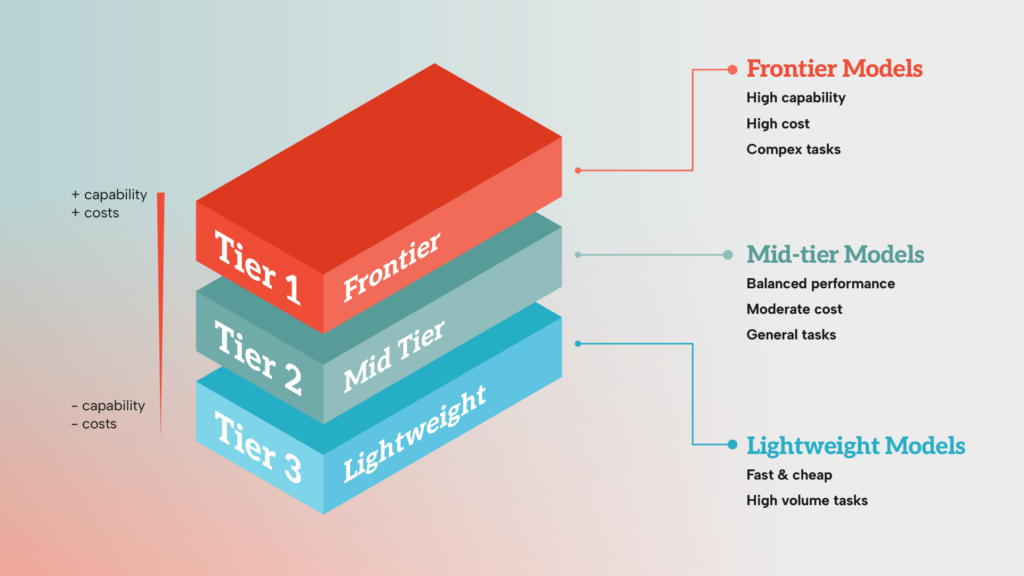
A practical model strategy for enterprise deployments is built on three tiers, each matched to a different category of task requirements. The boundaries between tiers are not rigid, and the specific models that occupy each tier will shift as the market evolves. The framework, however, is durable.
Tier 1: Frontier Models
Frontier models are the most capable, most expensive, and slowest models in the stack. They are appropriate for a minority of enterprise AI tasks: those that genuinely require top-tier reasoning, creativity, or long-context synthesis.
Use cases suited to Tier 1:
- Complex multi-step analysis requiring synthesis across large bodies of information
- High-stakes content generation where quality and nuance are critical
- Novel or ambiguous tasks that fall outside the training distribution of smaller models
- Agentic workflows where the model is making consequential decisions with limited human review
- Tasks where error costs are high and quality thresholds demand maximum model capability
Tier 2: Mid-Tier Models
Mid-tier models offer a substantial reduction in cost and latency relative to frontier models while retaining strong performance across a wide range of business tasks. For many enterprise use cases, mid-tier models represent the best balance of capability and cost efficiency.
Use cases suited to Tier 2:
- Document summarization and structured reporting
- Customer communication drafting and editing
- Code generation for well-defined functions and patterns
- Moderate-complexity question answering with retrieved context
- Workflow orchestration and planning where decisions are bounded by clear parameters
- Content review and quality assurance
Tier 3: Lightweight and Specialized Models
Lightweight models are optimized for speed, cost, and efficiency on specific categories of tasks. They are not general-purpose reasoning engines but they are highly capable within their design parameters. Specialized models, including fine-tuned variants and task-specific classifiers, belong in this tier as well.
Use cases suited to Tier 3:
- Document and request classification and routing
- Structured data extraction from forms and templates
- Intent detection and query categorization
- Named entity recognition and information tagging
- Simple, templated content generation
- Screening and triage steps within larger agentic workflows
Implementation Strategy: Building a Tiered Model Architecture
Step 1: Audit and Classify Your Current AI Workload
Catalog every AI-powered workflow in your stack, documenting task type, model assignment, call volume, and cost per call. This audit typically reveals a small number of high-volume, low-complexity tasks that are significantly over-engineered.
Step 2: Define Quality Thresholds for Each Use Case
Work with business owners to define specific, testable quality thresholds for each use case. “High quality” is not a threshold; “extraction accuracy above 97 percent on standard form types” is.
Step 3: Benchmark Smaller Models Against Your Thresholds
For each use case where a smaller model might be appropriate, run a structured benchmark using real production data. Measure against the quality thresholds from Step 2, along with latency and cost per call.
Step 4: Redesign the Architecture and Implement Routing
Redeploy use cases that a smaller model can handle to the appropriate tier. For mixed-complexity workloads, consider a routing layer that directs requests to the right model based on task complexity.
Step 5: Monitor, Measure, and Reassign Regularly
Build quality monitoring into every tier assignment and schedule a formal review at least quarterly. The model market moves quickly enough that an optimal assignment from six months ago may already be leaving savings on the table.
Common Optimization Mistakes and How to Avoid Them
Even well-intentioned cost optimization efforts can backfire without the right approach.
Here are the 5 most common cost optimization mistakes to watch for.
1. Optimizing for Token Cost Alone
Token cost is just one component of total AI cost. Error correction, human review, and latency-driven infrastructure costs all contribute, so optimize for total cost per quality-adjusted output.
2. Benchmarking on Clean Data
Most benchmarks use clean, well-formatted inputs, but production data is messier. Always benchmark on real production samples before committing to a downtiered model.
3. Setting and Forgetting Tier Assignments
The model landscape changes quickly, and a frontier model from 18 months ago may now be mid-tier in capability and low-tier in cost. Review tier assignments regularly to capture ongoing savings.
4. Ignoring Fine-Tuning as an Option
A fine-tuned smaller model can outperform a general-purpose frontier model on a specific task at a fraction of the cost. For high-volume, well-defined tasks, the upfront investment is often recovered within weeks.
5. Centralizing Model Selection Without Use Case Context
Cost optimization driven purely by a central team often fails because that team lacks the business context to set accurate quality thresholds. Effective model strategy requires collaboration between platform teams and the business units who understand acceptable failure modes.
Measuring Cost Optimization Effectively
Cost optimization that sacrifices undetected quality is not optimization; it is technical debt accumulation. The measurement framework for a tiered model strategy must track both sides of the equation.
Cost Metrics
- Cost per task completion by use case and model tier
- Total AI inference spend by business unit and use case
- Cost per quality-adjusted output (cost divided by the percentage of outputs meeting quality threshold)
- Savings realized from tier reassignments, tracked monthly
Quality Metrics
- Output accuracy and quality rate by model tier and use case
- Error and correction rate by use case, with trend tracking
- User override and rejection rate for AI outputs, segmented by tier assignment
- Escalation rate in tiered routing architectures (the percentage of requests escalated from a lower tier to a higher tier)
Efficiency Metrics
- Average latency by model tier and use case
- Throughput per dollar of inference spend
- Infrastructure cost associated with latency-sensitive deployments
A healthy tiered architecture shows declining cost per quality-adjusted output over time, stable or improving quality metrics, and a routing escalation rate that reflects realistic task complexity distribution rather than systematic under-tiering.
Future Outlook: Where Model Economics Are Heading
Several trends will shape model cost optimization strategy over the next two to three years.
Accelerating Capability Compression
Capabilities that required frontier models twelve months ago are increasingly available in mid-tier and lightweight models. This trend is accelerating. Organizations that build dynamic tier assignment processes will capture the savings from capability compression as it happens. Those with static assignments will leave those savings on the table.
Specialized and Domain-Specific Models
The model market is increasingly moving beyond general-purpose architectures toward domain-specific models trained on industry data. In financial services, healthcare, legal, and other specialized domains, purpose-built models often outperform general frontier models on domain-specific tasks at significantly lower cost. Tracking the specialized model landscape relevant to your industry is becoming a strategic capability in its own right.
On-Premise and Private Cloud Deployment
As model capabilities compress into smaller architectures, the case for deploying lightweight and mid-tier models in private cloud or on-premise environments is strengthening. This eliminates per-token API costs entirely for high-volume tasks and addresses data residency and privacy requirements simultaneously. Organizations investing in the operational capability to run and maintain their own model deployments will have structural cost advantages for their highest-volume use cases.
Inference Optimization Tooling
The ecosystem of tools for optimizing AI inference, including quantization, caching, batching, and speculative decoding, is maturing rapidly. These techniques can reduce inference costs substantially without any change to model selection. Building familiarity with inference optimization into your AI platform team’s competency set is an investment that compounds over time.
Taking Action & Where to Start
Weeks 1–2: Cost Audit. Pull your current AI infrastructure spend and decompose it by use case and model. Identify the five to ten highest-cost use cases and document the task type, volume, and current model assignment for each. This audit will almost always surface two or three obvious candidates for immediate retiering.
Month 1: Quality Threshold Definition and Benchmarking. For your top cost candidates, define explicit quality thresholds with business stakeholders. Run structured benchmarks against one or two smaller model options using production data samples. Document results against the thresholds and calculate the projected cost impact of reassignment.
Month 2: Pilot Retiering and Monitoring. Reassign the two or three highest-impact use cases to more appropriate model tiers in a controlled pilot. Instrument quality and cost monitoring from day one. Run the pilot for four to six weeks before drawing conclusions, long enough to capture realistic variance in input complexity.
Months 2–4: Architecture Redesign and Routing Implementation. Based on pilot results, redesign the broader model architecture. For mixed-complexity workloads, implement routing logic that directs requests to appropriate tiers dynamically. Establish the quarterly review cadence for tier assignments and assign ownership to a specific team or role.

A mature AI model strategy is not the one that uses the most powerful models. It is the one that uses the right models, delivers consistent quality at every tier, and builds the operational discipline to keep those assignments current as the model landscape evolves. Organizations that get this right will not just reduce their AI infrastructure costs. They will build a more scalable, more defensible AI program that can expand to more use cases without a linear increase in cost.
Want to assess the cost optimization potential in your current AI model architecture? Contact our team to explore a model strategy review and identify the highest-impact opportunities in your specific environment.