Introduction
Over the past year, technology has reminded every organization, from Fortune 500 banking, healthcare, and energy companies to federal agencies, that cloud reliability is not guaranteed. Even the most mature enterprises have faced unexpected disruptions that tested their continuity plans, user trust, and digital supply chains.
Outages and Resiliency
These events, such as mainstream outages, underscore a critical reality: resilience is no longer a feature of cloud architecture. It’s the foundation. These kinds of outages are not just a glitch; they are a warning about the risks of putting all your trust in a single cloud provider or region. Multi-region architecture is no longer a “nice-to-have” for fault tolerance; it’s a competitive differentiator and is imperative to business survival. The question isn’t whether we can afford a multi-region architecture. It’s whether we can afford not to.
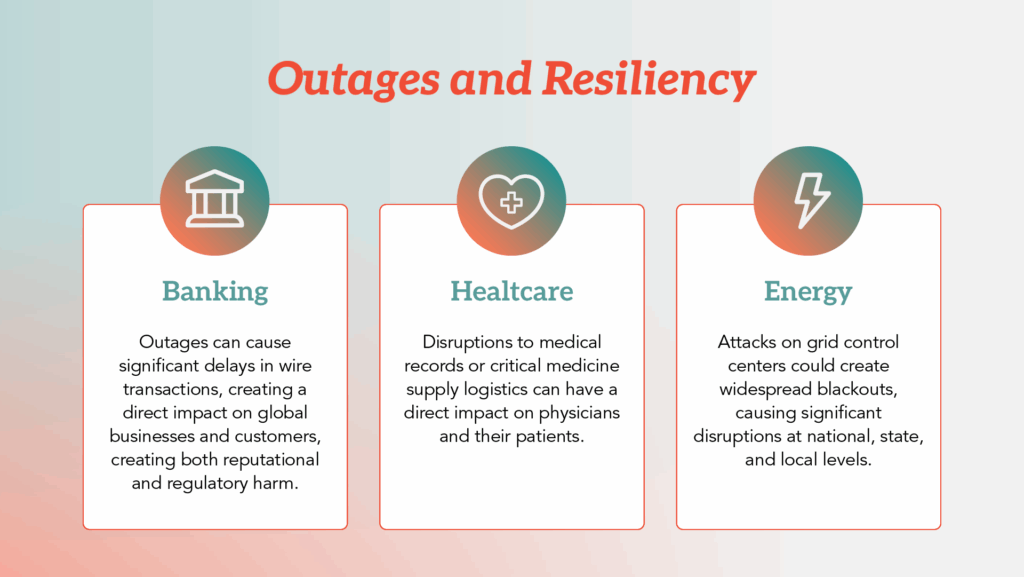
Banking: Outages can cause significant delays in wire transactions, creating a direct impact on global businesses and customers, and creating both reputational and regulatory harm.
Healthcare: Disruptions to medical records or critical medicine supply logistics can have a direct impact on physicians and their patients.
Energy: Attacks on grid control centers could create widespread blackouts, causing significant disruptions at national, state, and local levels.
The New Definition of Resilience Amidst Outages
For years, “high availability” meant running across multiple zones or instances. But today’s interconnected technologies require a deeper approach, one that assumes failures will happen and systems must be designed to absorb and recover from them seamlessly.
In today’s fast-moving economy, the concept of “two is one and one is none” could not be more relevant in designing your business systems and product operations for resilience and reliability.
Resilient architecture is not just about redundancy. It’s about distributed design, automation, and intelligent recovery. Enterprises that are architected with these principles in mind reduce downtime, control costs, and maintain customer confidence even in the face of unpredictable events or large-scale outages.
From Uptime to Business Continuity
While cloud service providers offer robust infrastructure, the shared responsibility model places resilience squarely on the customer’s shoulders. Organizations that depend on single-region or tightly coupled workloads expose themselves to systemic risks that can ripple across business units.
True continuity requires:
- Active-active multi-region design: ensuring workloads can shift dynamically without human intervention.
- Automated failover and recovery: eliminating manual runbooks that slow response times.
- Observability and real-time telemetry: enabling teams to see and act on potential disruptions before they impact users.
At Oteemo, we view resilience as an outcome of architectural intent, not an afterthought. Our cloud modernization frameworks are orchestrated around the idea that every workload should be portable, observable, and recoverable at scale.
Automation: The Core of Resilient Operations
Automation is the backbone of reliability. When infrastructure, deployment, and compliance processes are codified, organizations can recover faster, maintain consistency across environments, and scale operations with confidence.
Oteemo’s experience across commercial and federal programs has shown that resilient enterprises share three traits:
- Infrastructure-as-Code (IaC) frameworks that standardize recovery across regions.
- Event-driven architectures that respond to performance thresholds or service degradation in real time.
- Continuous validation, proactive testing of failover, security, and observability pipelines to confirm readiness.
By integrating these capabilities into modernization initiatives, we help organizations achieve what we call “designed resilience,” a state where recovery is predictable, measurable, and automated.
Building for the Future
As the pace of digital transformation accelerates, cloud architecture must evolve from being efficient to being resilient by design. This is especially true for organizations operating in highly regulated or mission-critical environments, where every minute of downtime carries operational and reputational costs.
The lesson for 2025 is clear: resilience is not just an engineering discipline, it’s a business strategy. Enterprises that thrive in the next decade will be those that treat reliability as a competitive differentiator, not a compliance checkbox.
Conclusion
The future of cloud is not about avoiding disruption, it’s about outpacing it. By designing for resilience, automating for consistency, and monitoring for insight, organizations can operate with confidence, knowing their systems are prepared for the next disruption.
At Oteemo, we have partnered with enterprises in financial services, healthcare, energy and national defense to build cloud ecosystems that are not only modern and secure but also resilient by intent, ensuring performance, reliability, and business continuity across every environment. Get in touch to see how we can support your resiliency mission.
FAQS
What is resilient cloud architecture?
Resilient cloud architecture is a design approach that ensures systems remain available and performant even when individual components fail. It uses distributed, automated, and self-healing frameworks that anticipate disruption and maintain continuity across regions or environments.
How do resilient cloud architectures help against major outages?
Resilient architectures minimize the impact of disruptions by spreading workloads across multiple regions or availability zones. When an outage occurs, automated failover and recovery mechanisms redirect traffic seamlessly, keeping applications online and reducing downtime.
How do enterprises build resilient cloud ecosystems?
Enterprises build resilience by combining multi-region design, Infrastructure-as-Code (IaC), observability, and automated recovery testing. Partnering with experts in cloud modernization helps organizations embed resilience principles early in their architecture, not as a reaction to downtime.
How can enterprises avoid disruptive outages?
Avoiding outages requires proactive design and testing. Continuous monitoring, automated failover, and chaos engineering allow teams to identify weaknesses before they affect users. Regular resilience testing ensures recovery procedures work under real-world conditions.
What role does automation play in resilient cloud architecture?
Automation is the backbone of resilience. It enables rapid failover, consistent environment configuration, and repeatable recovery processes. By codifying infrastructure and response workflows, enterprises reduce human error and accelerate recovery from potential disruptions.