
Key Takeaways
- AI agents fundamentally change the Zero Trust threat model. Unlike traditional services, agents reason dynamically, consume untrusted natural-language inputs, call external tools, hold credentials, and determine their next actions at runtime.
- Identity should follow every individual request. Agents should operate using short-lived, narrowly scoped credentials tied to the user they are acting for, rather than relying on persistent service-level credentials.
- Every agent action needs a policy enforcement checkpoint. The model can propose an action, but an independent enforcement layer should determine whether that action is actually permitted to execute.
- Prompt injection should be contained, not assumed preventable. Rather than relying on filters to perfectly distinguish instructions from malicious or untrusted content, organizations should design systems where a manipulated agent still cannot exceed the user’s authority, approved destinations, or established limits.
- Autonomous agents need hard boundaries. Tool recursion, token consumption, spending, network access, permissions, and high-risk actions should all have enforceable limits that fail safely.
- Observability is part of the security architecture. Organizations should be able to trace an agent’s actions back to the user, prompt, permissions, and decision that produced them.
- The core Zero Trust principle for agents is separation of intelligence and authority. Give the reasoning engine freedom to propose actions, while giving the enforcement layer the authority to permit very little by default.
- Oteemo AXIOM™ applies these principles at the platform level. The architecture uses per-request identity, no ambient authority, continuous re-authorization, egress controls, bounded blast radius, and controls around tools and MCP servers.
Zero Trust began as a network idea: stop assuming that anything inside the firewall is safe. Its one enduring sentence (never trust, always verify) was written for laptops and services. AI agents strain every word of it.
A traditional service does one predictable thing. An agent decides what to do next from natural-language input it cannot fully vouch for, calls tools you may not have written, and chains those calls in loops. It holds real credentials and it is, by design, persuadable. That combination turns a security model built for known software into a model that has to govern improvisation.
As NIST put it in SP 800-207, “trust is never granted implicitly but must be continually evaluated.” That was written for a principal that connects. An agent is a principal that reasons, and that raises the stakes on every word of it.
Why agents break the old model
Four properties, each fine in isolation, together describe an actor the perimeter never planned for.
It has no fixed identity. An agent is a non-human principal that borrows a human’s authority. If it authenticates as “the app,” every user’s blast radius becomes the app’s blast radius. Identity has to travel with the individual request, not the deployment.
It is autonomous. The sequence of actions isn’t fixed in code; it’s generated at runtime. You cannot enumerate ahead of time everything the agent will attempt, so you cannot rely on reviewing the call graph. You have to police each call as it happens.
It is a confused deputy by construction. The agent holds privileges the requester does not, and takes instructions from content the requester does not control. That is the textbook setup for the confused deputy: a trusted actor tricked into misusing its authority.
Its inputs are hostile by default. A retrieved web page, a tool result, a pasted document: all of it enters the same context window as your instructions, and the model cannot reliably tell command from data. Untrusted text is not an edge case; it’s the medium the agent swims in.
Every action passes a checkpoint
Zero Trust for agents collapses to one move: put a policy enforcement point between the model’s intent and any real-world effect. The model may decide anything; the checkpoint decides what actually happens. Intent flows through only after each gate passes, and a failed gate fails closed: the effect executes, or it is denied, logged, and returned as a plain error.
The gates are the pillars below.
Seven pillars with verifiable gates
These aren’t a sequence to complete once. They’re properties every single agent action must satisfy, every time. Treat any one as optional and it becomes the way in.
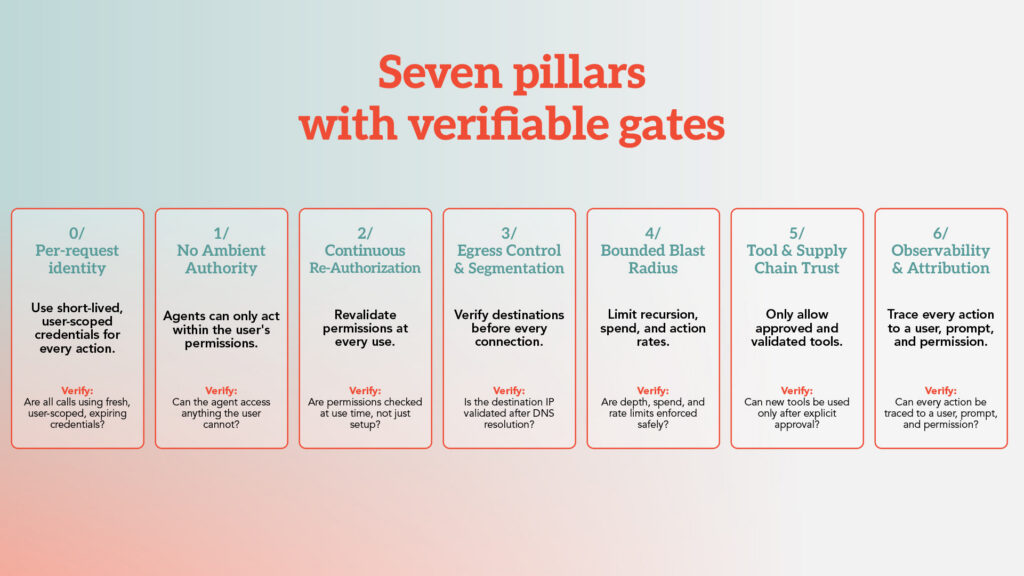
0 Per-request identity, not deployment identity
Mint a short-lived, narrowly-scoped credential for the acting user at the moment of the call, not a long-lived service key the agent carries around. If the token leaks, it expires in minutes; if you need to know who did something, the token already says so.
Verify: does every downstream call carry a fresh, user-scoped, expiring credential?
1. No ambient authority: the agent inherits the user’s ceiling
The tool layer should grant zero privilege of its own. The cleanest way to guarantee this is to route agent actions back through the same authorization the user’s own requests traverse, so the agent can never do something the user couldn’t do by hand.
Verify: can the agent reach any capability the user lacks? It must not.
2. Continuous re-authorization
A permission granted yesterday is not consent today. Re-check trust at use time: if the person who configured a powerful integration has since lost that permission, the integration must stop working; the stored config fails closed rather than coasting on a stale grant.
Verify: is authority re-evaluated at call time, or only at setup time?
3. Egress control and segmentation
An agent that can be told to fetch a URL can be told to fetch 169.254.169.254 or your internal database. Validate the resolved address at connect time, not just the hostname, so DNS rebinding can’t slip a public name past you and land on a private target.
Verify: is the destination IP checked after DNS resolution, on every connection?
4. Bounded blast radius
Autonomy needs a stop. Cap tool-loop recursion so a runaway agent can’t spin forever; cap token and spend budgets per user and per model; rate-limit the expensive verbs. Limits should degrade gracefully (downgrade the model, return a clear message), not take the whole system down.
Verify: is there a hard ceiling on depth, spend, and rate, and does exceeding it fail safe?
5. Tool and supply-chain trust
Every tool and MCP server the agent can reach is attack surface. Allowlist which servers are reachable, gate the high-risk capabilities (anything that mints or forwards delegated credentials) behind an explicit permission, and validate third-party action specs before they’re ever attached.
Verify: is a new tool reachable only after an explicit, permissioned decision?
6. Observability and attribution
If you can’t reconstruct what an agent did, on whose behalf, and why, you have no Zero Trust; you have hope. Every action should be attributable to a user and a decision, logged, and revocable. This is what turns “the agent did something weird” into an investigation instead of a shrug.
Verify: can you trace any effect back to a user, a prompt, and a granted permission?
Prompt injection is a confused-deputy problem, not a spelling problem
It is tempting to treat prompt injection as something a good enough input filter will catch. It won’t. Reliably distinguishing instructions from data in free text is unsolved, and a filter that mostly works is a filter attackers optimize against.
The durable answer is containment, not inspection. Assume the model will be talked into trying something malicious, and make sure the attempt hits a wall: it can only act as the user, only reach allowlisted destinations, only within budget, and every attempt is logged. When injection succeeds at the language layer but fails at the authority layer, you’ve moved the fight to ground you can actually win.
The pattern, in one line
Give the reasoning engine freedom to propose anything, and give the enforcement layer authority to permit almost nothing by default. The intelligence lives in the model; the trust lives in the gates around it. Keep those two things apart and Zero Trust for agents stops being a slogan and becomes an architecture.
How AXIOM handles it
AXIOM applies this pattern rather than bolting security on afterward. Briefly:
- Per-request identity. When an agent acts as you, the platform mints a two-minute, user-scoped JWT (“long enough for one tool call, no longer”), verified with a timing-safe secret comparison, and fails closed if any piece is missing.
- No ambient authority. The agent’s built-in tools call the platform’s own REST API over loopback (127.0.0.1) carrying that minted token, so every action re-traverses the same auth, permission, and per-resource ACL a human request does. The tool layer grants nothing extra.
- Continuous re-authorization. Delegated-token (OBO) integrations are re-checked at use time: if the author who configured one has since lost the CONFIGURE_OBO permission, the stored config fails closed instead of coasting on a stale grant.
- Egress control. A shared SSRF guard validates the resolved IP at connect time (defeating DNS rebinding) and blocks private ranges, cloud-metadata endpoints, and internal service names. Exemptions must be scoped to host:port, never a whole host.
- Bounded blast radius. Tool-loop recursion is capped (memory subagents hard-capped at depth 3); per-user, per-model monthly token allowances enforce budgets with an automatic cheapest-first fallback ladder, and governance lookups fail open so they never take chat down.
- Tool and supply-chain trust. MCP servers are gated behind MCP_SERVERS.USE/CREATE permissions and per-server domain allowlists; third-party OpenAPI action specs are validated for SSRF before an action is ever attached.
The signature move is deliberately giving the agent’s tool layer zero standing power; it holds no privileged key at all. It mints a two-minute token for you and knocks on the platform’s own front door over loopback, so a compromised or manipulated agent inherits exactly your access and not one permission more.
FAQs
1. What is Zero Trust for AI agents?
Zero Trust for AI agents applies the principle of “never trust, always verify” to autonomous AI systems. Rather than trusting an agent because it is operating inside an approved application or environment, every action should be independently authenticated, authorized, constrained, and logged before it creates a real-world effect.
2. Why do AI agents require a different Zero Trust security model?
AI agents differ from traditional applications because their sequence of actions is generated dynamically rather than completely defined in advance. They can consume untrusted information, interact with external tools, operate using delegated authority, and make decisions at runtime. This makes per-action authorization and enforcement critical.
3. How can Zero Trust reduce the security risks of prompt injection?
Zero Trust does not depend on detecting every malicious prompt. Instead, it limits what happens if an agent is successfully manipulated. An agent can be restricted to the user’s existing permissions, approved destinations and tools, defined budgets, and other policy controls, with its actions logged for investigation and attribution.
4. What security controls should organizations implement for AI agents?
The article identifies seven core areas: per-request identity, elimination of ambient authority, continuous re-authorization, egress control and segmentation, bounded blast radius, tool and supply-chain trust, and observability and attribution. These controls should apply to individual agent actions rather than being treated as a one-time security review.
5. How does Oteemo AXIOM™ implement Zero Trust for AI agents?
Oteemo AXIOM™ separates an agent’s reasoning capability from its authority to act. The platform uses short-lived user-scoped credentials, routes agent actions through existing authorization and ACL controls, re-checks delegated permissions at use time, controls network egress, limits agent recursion and consumption, and governs access to MCP servers and third-party actions. The result is an agent that inherits the user’s permitted access rather than holding standing privileged authority of its own.