Executive Summary
For most enterprises, the AI journey began with copilots: assistants that sit alongside employees, speeding up individual tasks while keeping humans firmly in control. It was a sensible starting point. But organizations that treat copilots as the destination are hitting a ceiling they didn’t anticipate.
The next evolution is autonomous AI agents: systems that don’t assist with workflows, but own them end-to-end. For enterprise leaders focused on measurable business outcomes, this distinction isn’t academic. It’s the difference between incremental efficiency gains and structural competitive advantage.
Key Takeaways:
- Copilots have a structural ROI ceiling because human bottlenecks remain at every handoff
- Autonomous agents can process multiples of current volume without proportional headcount increases
- Success depends on three conditions: clear outcomes, real tool access, and designed-in oversight
- Measuring agentic AI requires outcome metrics, not activity metrics
- Early adopters are building operational capabilities that will be difficult for competitors to replicate
Understanding the Shift: From Copilots to Autonomous Agents
To understand why this transition matters, consider how the two paradigms actually differ:
Copilots / AI Assistants: Respond to prompts, compress task time, keep humans in the loop at every step
Autonomous Agents: Receive a goal, plan and execute multi-step workflows, handle exceptions, and deliver outcomes, escalating to humans only at genuine decision boundaries
The economic difference is stark. A copilot drafts an email and a human edits and sends it. A copilot generates a report and a human validates and presents it. The AI compresses time at each step, but the workflow still runs through a human bottleneck at every handoff. You are paying for AI while still paying for the full cost of human attention.
An autonomous agent doesn’t assist with a workflow. It is the workflow
Consider a financial services firm processing loan applications. A copilot helps underwriters write faster summaries. An autonomous agent ingests the application, pulls credit data, cross-references lending policy, flags exceptions, models risk scenarios, drafts the recommendation, and routes for human sign-off only when it reaches a decision it isn’t authorized to make independently. The copilot saves the underwriter 20 minutes. The agent processes three times the volume with the same team.
Common Misconceptions Addressed
Myth: Autonomous agents are just more powerful copilots
Reality: They represent a different architecture entirely. Agents own outcomes, not just individual tasks. The business model is fundamentally different.
Myth: Agents replace the need for human judgment
Reality: Well-designed agents escalate to humans at genuine decision boundaries. The goal is to remove humans from the repetitive work, not from the consequential work.
Myth: This technology isn’t ready for enterprise deployment
Reality: Organizations are already achieving measurable ROI in document processing, customer onboarding, compliance review, and IT operations today, not in some future state.

Core Capabilities That Enable Agentic ROI
Understanding what makes autonomous agents viable for enterprise deployment clarifies both where they excel and where they require careful scoping.
- End-to-End Workflow Ownership
Unlike copilots that assist with individual steps, agents can manage entire processes: receiving a high-level objective, decomposing it into tasks, executing across multiple systems, and handling exceptions without human intervention at each stage. - Real Tool Integration and Write Access
This is the capability most organizations underestimate. Agents that can only read data aren’t truly autonomous; they’re dashboards with extra steps. Genuinely autonomous agents have credentialed, auditable write access to the systems required to complete work: updating records, triggering workflows, sending communications, and closing loops. - Adaptive Exception Handling
When encountering obstacles or new information, agents can modify their approach dynamically rather than failing or waiting for human instruction. This adaptability is what allows them to manage real-world processes that rarely follow the clean, linear path documentation describes. - Persistent Context Across Sessions
Unlike stateless AI interactions, agentic systems maintain memory of prior actions, outcomes, and edge cases, allowing them to improve over time and maintain continuity across long-running workflows.
Strategic Benefits for Enterprise Leaders
Autonomous agents deliver strategic value that goes beyond productivity gains, targeting throughput, scalability, and unit economics in ways that show up in financial results. Key benefits include:
- Throughput gains: By removing the human bottleneck from the critical path, well-scoped agents enable volume increases measured in multiples, not percentages.
- Scalable expertise: Agents can embody best practices and operate 24/7 across time zones, scaling institutional knowledge without proportional headcount growth.
- Structural cost advantage: Measured at the workflow level, the right question is not how much time AI saves per task, but what the fully-loaded cost per unit of work looks like before and after the agent.

Implementation Strategy: The Three Conditions for Agentic ROI
Not all agent deployments deliver. Many fail quietly, dismissed as “not ready” when the real issue is a mismatch between agent capability and deployment architecture. Three conditions consistently separate high-ROI deployments from expensive experiments.
Condition 1: The Workflow Has a Clear Definition of Done
Agents thrive on tasks with legible success criteria. “Resolve this customer support ticket” is a better agent task than “improve customer satisfaction.” The former has a finish line; the latter is an ongoing judgment call. Before deploying an agent, you should be able to write an acceptance test: what does a successful run look like, and how would you know if it failed?
Condition 2: Tool Access Matches Task Scope
Autonomous agents require real integrations: credentialed, auditable access to the systems they need to complete work. Organizations getting the most from agentic AI have invested in the integration layer. This is frequently the gap between a compelling demo and a production deployment that delivers ROI.
Condition 3: Human Oversight Is Designed In, Not Bolted On
The most dangerous failure mode in agentic AI isn’t the agent that does something catastrophically wrong. It’s the agent that quietly does the wrong thing thousands of times before anyone notices. High-ROI deployments build oversight into the architecture from day one: confidence thresholds that trigger human review, audit logs that make agent decisions inspectable, and clear escalation paths for edge cases. Oversight isn’t the opposite of autonomy. It’s what makes autonomy trustworthy enough to scale.
Recommended Starting Points by Function
Organizations with the strongest early results tend to begin in one of these areas:
- Back-office operations: Invoice processing, compliance screening, data reconciliation
- Customer-facing workflows: Tier-one support, onboarding, appointment scheduling
- IT operations: Incident triage, alert routing, routine remediation
- Document-intensive processes: Loan origination, contract review, regulatory reporting
Rethinking Success Metrics
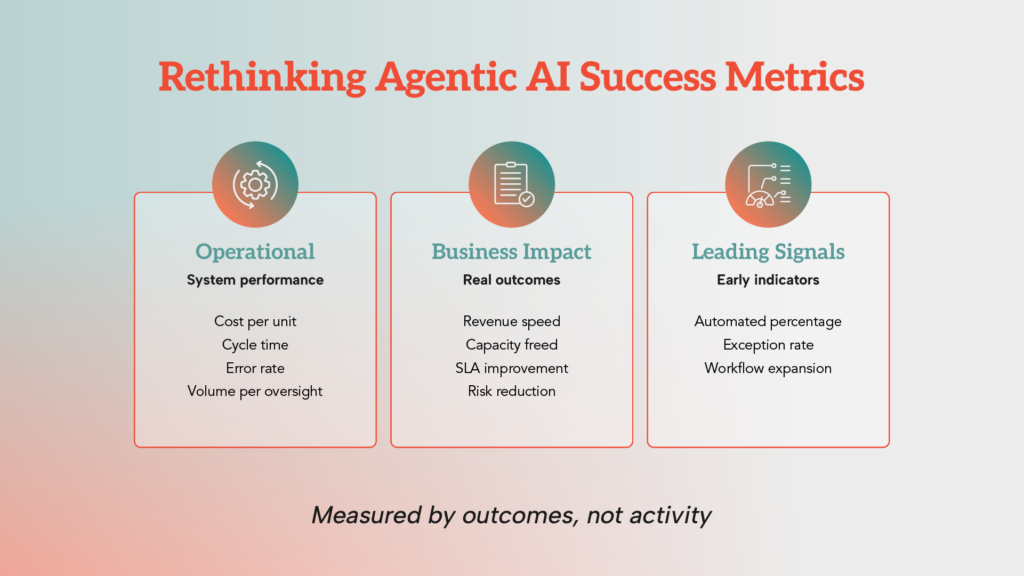
If you’re measuring agentic AI investments the same way you measured copilot investments, you will get misleading signals. Copilot metrics are activity metrics: time saved per task, prompts per user per week. These measure utilization. They tell you almost nothing about business impact.
Agentic AI demands outcome metrics:
Operational Metrics
- Cost per unit of work completed, before and after deployment
- End-to-end cycle time for the target workflow
- Error and exception rates, and their trajectory over time
- Volume processed per unit of human oversight
Business Impact Metrics
- Revenue cycle acceleration
- Headcount capacity freed for higher-value work
- Customer-facing SLA improvements
- Risk and compliance incident reduction
Leading Indicators
- Percentage of workflow steps handled without human intervention
- Exception escalation rate (declining over time is a positive signal)
- Cross-functional expansion velocity
One framework gaining traction is measuring agents the way you’d measure a business process outsourcing relationship: did the output meet spec, at what cost, at what volume, and with what quality?
This reframe moves the conversation from “is AI useful” to “is this process now operating at a competitive cost structure?”
The Organizational Dimension Nobody Talks About
Technical leaders often underestimate the human side of agentic deployment. Copilots don’t threaten anyone’s job description; they make people faster. Agents are more complicated. When an agent owns a workflow end-to-end, the question of what the person who used to own that workflow now does is real, and it deserves a real answer.
Organizations that navigate this well do two things. First, they are transparent about it and don’t frame agents as “tools” while quietly planning headcount reductions. Second, they invest in redeployment, moving people from high-volume repetitive work the agent now handles to higher-judgment work that still requires human expertise.
The firms that treat agentic AI purely as a cost-reduction play tend to generate short-term savings and long-term capability deficits, as experienced people leave and institutional knowledge walks out the door. The firms that treat it as a capacity expansion play, processing more, serving more, and building more without proportionally growing headcount, tend to build durable competitive advantages.

Where This Is Heading
The current generation of autonomous agents excels at well-scoped, high-volume, rules-heavy workflows. The next wave will extend their reach significantly:
Multi-Agent Coordination
Rather than single agents owning individual workflows, multi-agent systems will allow specialized agents to collaborate on complex, cross-functional processes. Each agent handles a domain of expertise while coordinating toward shared business objectives.
Deeper Enterprise System Integration
As integration standards mature and enterprise software vendors build native agent interfaces, the friction of deploying agents against real production systems will decrease substantially, expanding the addressable workflow landscape.
Adaptive Learning at Scale
Future agentic systems will build richer institutional memory over time, not just performing known workflows more reliably but identifying process improvement opportunities and proposing optimizations proactively.

For enterprise leaders ready to move beyond copilots
Below is a practical sequence for enterprise leaders who are ready to take action and start:
Weeks 1–2: Honest Assessment
Evaluate your data integration maturity, process documentation quality, and governance readiness. The organizations that struggle with agentic deployment almost always have a data infrastructure problem, not an AI problem.
Month 1: Use Case Identification
Map your highest-volume, most rules-heavy workflows. Prioritize based on two criteria: business impact if cycle time and cost are improved, and feasibility given current data and integration access.
Month 2: Pilot Design
Select one workflow that has a clear definition of done, measurable outcomes, and bounded risk. Design oversight mechanisms before writing a single line of integration code.
Months 2–4: Pilot Execution and Measurement
Execute with rigorous measurement against the outcome metrics defined above. The pilot’s value is as much the organizational learning as the direct ROI. Your team’s ability to scope, deploy, and govern agentic systems is the asset you’re building.

The shift from AI assistance to AI autonomy is ultimately less a technology decision than a business architecture decision. The window for building a meaningful head start is open, but not indefinitely. The companies deploying autonomous agents effectively today aren’t just capturing near-term efficiency gains. They’re building the operational DNA for a competitive posture their peers will find very difficult to replicate.
Ready to assess your organization’s readiness for autonomous AI? Contact our team to see a live demonstration of agentic workflows in action and explore where the highest-value opportunities exist in your business.