Key Takeaways
- AI-enabled software development goes beyond AI-assisted coding. It embeds AI across the full software development lifecycle, including planning, coding, testing, security, deployment, and operations. What Is AI Enabled Development
- AI works best as part of the engineering system, not as a standalone developer tool. Enterprise value comes from integrating AI with existing platforms, workflows, tools, and engineering standards. What Is AI Enabled Development
- Standardization and context are critical for enterprise AI. AI understands common development tools, but organizations must provide clear business rules, technical standards, and organizational context to produce reliable outcomes. What Is AI Enabled Development
- A modern software delivery foundation should come before AI at scale. Platform engineering, standardized environments, modern CI/CD, DevSecOps, observability, and enterprise architecture provide the foundation AI needs to operate effectively. What Is AI Enabled Development
- Governance enables organizations to scale AI safely. Enterprises need approved models and tools, data and IP protections, human oversight, auditability, and enforceable standards as AI agents become more widely used. What Is AI Enabled Development
- The path toward AI-native engineering should be incremental and measurable. Organizations can start by assessing their SDLC, identifying high-value AI use cases, modernizing the underlying platform, establishing governance, measuring outcomes, and scaling what works.
AI is like a wave washing over the IT industry, leaving some clutching to stay in place and others to let the currents carry them where they will. With things changing at such a brisk pace it can be daunting to decide which currents to take, but it need not be a painful process.
First, forget the hype. AI is undeniably useful, and it is getting better every day, but AGI is not a reality yet. I have seen AI do some amazing things, and I have also seen it fall flat on its face on a task a four-year-old could master. AI is a tool for increasing efficiency, and like any tool it can be used to create something beautiful or to create a nasty lawsuit if used improperly. The real question for any enterprise is not whether AI is coming. It is: how are you using AI right now, and is the environment around it ready?
This guide is about that environment. AI-assisted coding is only the beginning, and the more interesting shift is happening across the entire software development lifecycle. Let’s walk through what AI-enabled software development actually means, where it fits, and what it takes to do it well at enterprise scale.
What is AI-enabled software development?
AI-enabled software development is the practice of embedding AI across the full software delivery lifecycle, planning, building, testing, securing, deploying, and operating, inside a governed engineering environment, rather than pointing it at a single task like writing code.
It helps to separate three terms that get muddled together. Traditional development is all human effort: people write the code, the tests, and the pipelines, and respond to every incident by hand. AI-assisted coding drops AI into one spot, usually code generation, where a developer asks an assistant to draft a function or explain a snippet. The gain there is real, but it’s local, one person, one moment. AI-enabled development is the bigger idea. It treats AI as a capability of the whole system, spanning requirements, testing, security, deployment, and operations, and it runs inside an environment that gives it standards, governance, and visibility.
The distinction matters most at scale. One developer with an assistant is a personal productivity win. An organization that makes AI a property of its delivery platform changes how the entire engineering function performs. The first is a tool. The second is a system, and systems are what compound.
AI knows the tools, not your business
Before we get to everything AI can do across that system, there is a truth about it that shapes everything else: AI knows the tools, but it does not know you. It is genuinely smart about C#, GitHub, and Jira. It knows nothing about your company, your previous tech decisions, or the reasons behind them.
So, you must tell it, clearly and concisely, in a way that leaves no room for interpretation, and not the way you would explain it to another person. Files and context meant for AI consumption require specificity without assumption. “Send orders as appropriate” and “Send orders when payment status is complete” are two very different instructions. A human colleague fills that gap with judgment; an agent fills it with a guess. This is why standardization, all your practices and standards broken down and written down as makes sense, is the most important groundwork an organization can lay. It is the difference between AI that reinforces how you work and AI that quietly invents its own version of it.
That need only grows once you realize how connected AI is about to become, which is where the real opportunity starts.
AI is only as good as the tools you give it
AI is different from the software we’re used to. On its own, an AI will only spit text at you. Give it tools and it’s another story. For an agent, GitHub, Jira, and VS Code (and their equivalents) are all valid tools, which means AI is becoming interconnected in a way like the internet before it.
We are watching this happen from two directions at once. AI is being built into each of those tools individually, and at the same time a single agent can reach across all of them, and more, as a task requires. Like how calculus draws on the other mathematical disciplines, AI draws on our existing tools, extracts the rules for how things are supposed to work, and applies them to the job at hand. The result is a transformation that is hard to predict but genuinely exciting, because it stays open to the best solution rather than the one a rigid process allows.
This is why code generation, the most visible use of AI today, is only one part of the opportunity. Requirements Gathering, Ttesting, documentation, security, infrastructure, deployment, and operations can all become AI-enabled. The mental shift for enterprise leaders is to stop treating AI as another developer tool and start treating it as part of the development system.
Where AI fits across the software development lifecycle
A useful way to picture this is to map AI onto the lifecycle stages every team already knows:
Plan → Build → Test → Secure → Deploy → Operate
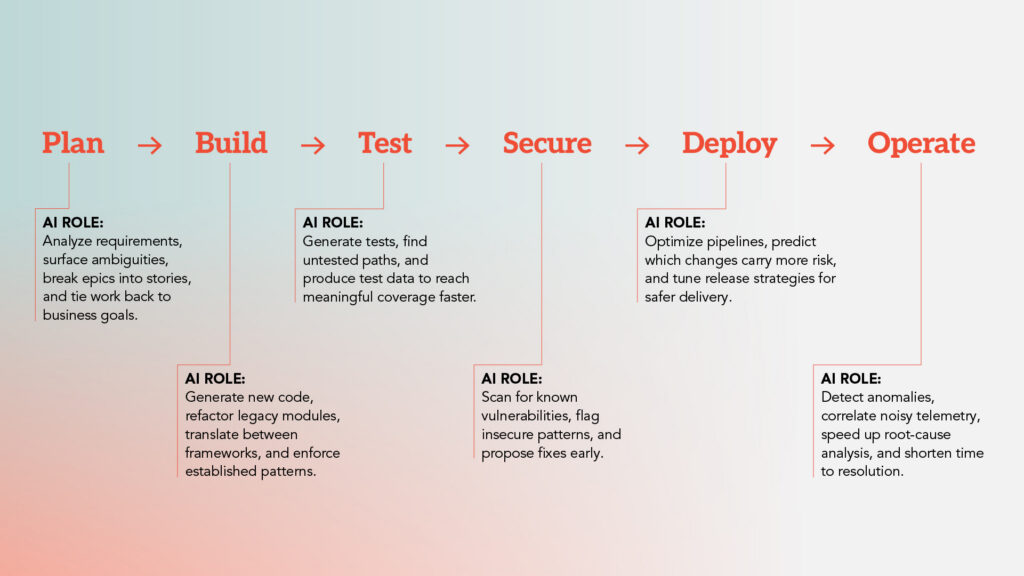
AI has a real role at each stage:
- Plan (requirements and planning): Analyze requirements, surface ambiguities, break epics into stories, and tie work back to business goals.
- Build (code generation and refactoring): Generate new code, refactor legacy modules, translate between frameworks, and enforce established patterns.
- Test (automated testing): Generate tests, find untested paths, and produce test data to reach meaningful coverage faster.
- Secure (vulnerability identification and remediation): Scan for known vulnerabilities, flag insecure patterns, and propose fixes early.
- Deploy (CI/CD optimization): Optimize pipelines, predict which changes carry more risk, and tune release strategies for safer delivery.
- Operate (observability and incident response): Detect anomalies, correlate noisy telemetry, speed up root-cause analysis, and shorten time to resolution.
No single stage is replaced. The value multiplies precisely because AI is present across all of them.
What this means for enterprise engineering teams
When AI is embedded across the lifecycle instead of isolated to coding, the benefits stop being personal and start being organizational. Development cycles get faster because there are fewer manual bottlenecks between stages. The repetitive work that quietly drains your best engineers, the boilerplate, the routine tests, the documentation nobody wants to write, gets handled with assistance, which frees those engineers for the design and the hard problems that actually need them. That is a better developer experience, and better experience is how you keep good people.
Delivery also gets more consistent, because AI working inside a standardized environment produces predictable output instead of a hundred variations on a theme. Two of the biggest payoffs, though, are the ones enterprises struggle with most on their own: modernizing legacy applications, where AI can accelerate the grind of understandi ng and refactoring aging code, and security and compliance, where policy checks and audit evidence can be generated continuously rather than assembled in a panic before an audit.
None of this is automatic, though. Every one of these outcomes depends almost entirely on the environment AI runs inside.
Why AI-enabled development requires more than AI tools
Here is the part organizations tend to learn the hard way: You cannot bolt AI onto an outdated software delivery environment and expect transformation. AI amplifies whatever system it runs inside. If that system is fragmented and poorly governed, AI amplifies the fragmentation.
Turning AI into durable advantage takes the same foundations that make any modern delivery work; they just matter more now. You need platform engineering to lay down the paved paths AI can build on, and standardized environments, so it produces consistent results across teams rather than one-off outcomes. You need modern CI/CD to move AI-generated changes safely and quickly, and DevSecOps so security is continuous instead of a gate someone slaps on at the end. And you need the connective tissue around all of it: Governance to define what AI is actually allowed to do, observability to see what is happening across both the software and the AI-assisted processes producing it, and enterprise architecture to keep AI-enabled work fitting a coherent strategy instead of scattering into a dozen point solutions.
Put simply, AI is a force multiplier, not a substitute for a modern delivery capability. Multiply a mess and you get a bigger mess.
Building a governed AI-enabled development environment
The main difference between an enterprise and a startup or small business is governance, demanded by problems of scale. AI development up to now has mostly been a solo affair: a developer sets up an AI in their environment and, as a natural consequence, starts building the skills and agents to go with it. As a solo endeavor, that is fine.
But what happens when there are ten of those developers? Or a hundred? Picture a hundred agents all called BugFixer, each doing something slightly different. Some are out of date. Some are broken. Some may be outright malicious. It is not hard to see the need for governance, or why frameworks like Axiom are now in high demand. We want to centralize and manage our agents the same way we did with repositories or project-management stories, and this will be a major theme in the year ahead.
This is also where standardization comes in full circle. The clear, unambiguous context we talked about earlier is what makes an agent behave correctly; governance is what makes sure those standards are enforced as you scale from one agent to a hundred. Standards without enforcement drift, and enforcement without standards has nothing to enforce.
A governed environment answers the risk questions with structure rather than restriction. It starts with deciding which models and tools are approved, so teams can innovate inside vetted boundaries instead of quietly piping your proprietary code into whatever service they found last week, which is really the heart of data and IP protection. It keeps humans accountable for what ships: AI proposes, but a person approves and owns the outcome. And it makes your standards and compliance rules something the system enforces automatically rather than something you hope everyone remembers, with an audit trail of what the AI generated and what a human signed off on, and a secure software supply chain so all that new speed does not quietly widen your attack surface.
Done well, none of these slows teams down. It does the opposite. Clear guardrails are exactly what let people move fast without looking over their shoulders.
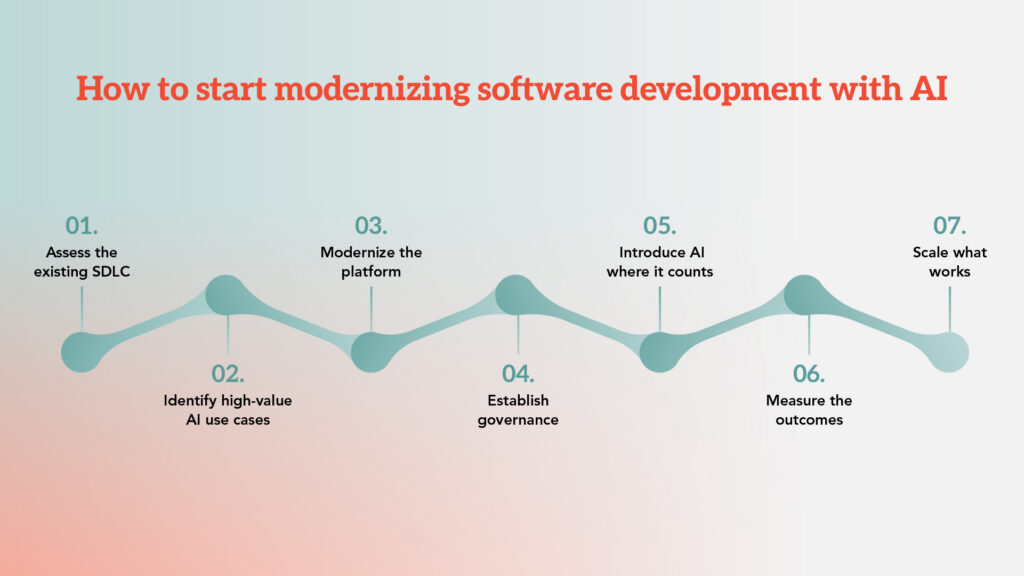
How to start modernizing software development with AI
You rarely need convincing that AI matters. The harder question is where to begin, and this is one place where a plain sequence genuinely helps:
- Assess the existing SDLC. Map how software actually gets planned, built, tested, secured, deployed, and operated today, and be honest about where it bottlenecks.
- Identify high-value AI use cases. Go after the workflows with clear, measurable impact first, things like test generation, legacy refactoring, or incident triage.
- Modernize the platform. Get platform engineering, standardized environments, and modern CI/CD in place, so AI has a solid system to run within, not a swamp.
- Establish governance. Decide on approved tools, data protection, oversight, and auditability before you scale, not after something goes wrong.
- Introduce AI where it counts. Roll it into the highest-value stages first, in a controlled way, and learn.
- Measure the outcomes. Track cycle time, quality, and security posture so you can prove value with data instead of anecdote.
- Scale what works. Take the patterns that paid off and extend them across teams, turning early wins into a real organizational capability.
From AI-assisted development to AI-native engineering
The trajectory is clear. Organizations start with AI-assisted coding, mature into AI-enabled development across the lifecycle, and move toward AI-native engineering, where AI is embedded across the software engineering lifecycle by design rather than added on afterward.
Getting there is not about acquiring more tools. Enterprise success comes from combining AI with modern platforms, skilled people, strong governance, and mature engineering practices. Any one of those alone underdelivers. Together they compound into a delivery capability that is faster, more secure, and more resilient than what came before.
The wave is not going to slow down. The organizations that thrive will be the ones that treat AI as a property of a modern engineering system, not a feature bolted onto a single editor, and let the current carry them somewhere better.
Modernize how your organization builds software with AI. Explore Oteemo’s AI-native development and modernization capabilities with Oteemo AXIOM.