Key Takeaways
- Develop trust in AI with structured frameworks and criteria for evaluating appropriateness for given business problems and make that analysis transparent
- Address all dimensions, people, process, and technology, of AI adoption when introducing it into business operations, especially human needs
- Build KSAs and address users’ (human-in-the-loop) needs when working with AI
- Organizations that invest in trust-centered design see measurably higher adoption and stronger long-term ROI
Driving Enterprise AI Adoption
Enterprise AI programs fail for many reasons: poor data quality, misaligned use cases, and inadequate governance. But one failure mode is often underestimated and rarely discussed in leadership conversations: TRUST.
Users simply do not trust a new enterprise system enough to use it.
Trust is not a soft metric. It is the adoption variable that determines whether an AI investment delivers its projected value or quietly atrophies into a line item no one defends at budget time. It is not built by capability alone, rather it is built by design.
Designing AI experiences that users trust entails applying AI appropriately to the correct business cases and addressing specific needs of the users (the humans-in-the-loop), interfacing with AI.
Design is an integral function to defining appropriate AI usage and can surface any concerns an organization needs to address head-on to build confidence. Design can be the difference between an AI system people use and one they work around and ignore.
Understanding the Adoption Gap
Why AI Capability Goes Unused
It is tempting to attribute low AI adoption as symptomatic of resistance to change or low organizational inertia. These factors are real. But research consistently points to a more fundamental issue: when users do not understand what an AI system is doing or why, they default to their prior workflow regardless of how capable the AI is. Moreover, trust further deteriorates as users observe AI results misaligned with human expertise and sentiment.
This is rational behavior, not obstinacy. Workers who are accountable for outcomes will not delegate decisions to a system they cannot effectively review, predict, or correct. A loan officer who cannot explain why AI flagged an application will not approve it without her own review. A customer service agent with an AI-generated recommendation that seems to miss specific circumstantial evidence will hesitate to act on that recommendation. In such scenarios, AI runs in the background while the human does the work anyway.
The result is an AI system with high deployment coverage and low actual utilization, a pattern that is far more common in enterprise settings than published case studies suggest. As AI projects proliferate, recognition that AI often functions more as an assistant than a “doer” is important; this reality prompts an important question around how organizations are accommodating the human-in-the-loop as they roll out AI across different business units.
The Trust Deficit in Enterprise AI
Trust in AI systems operates at two distinct levels that are frequently conflated in design conversations.
Dispositional trust is the user’s general orientation toward AI technology. This is shaped by prior experience, cultural context, and organizational culture. It is the starting condition that teams inherit and cannot fully control.
Situational trust is the user’s confidence in a specific AI system for a focused problem. This is shaped by repeated interactions that may or may not be tainted by bias and/or limited user insight into the extent to which the algorithm guards against incorrect conclusions or accommodates critical nuance. AI is not well-suited for tasks where judgment is involved. It relies heavily on data patterns rather than intangible cognitive, psychological, or creative inputs that define human intelligence.
Organizations can influence dispositional trust and have substantial leverage over situational trust. Design can play a key role in building both.

Designing for Trust in AI
Design can identify key concerns and challenges that employees face using AI to inform how organizations introduce the capability to support business operations. Data that emerges from design discovery serves a very important purpose: to identify the root causes for declining dispositional and situational trust as a critical starting point for evaluating AI applicability and adoption.
Situational Trust: As a discipline, design already showcases how internal business resources, including people, tools, and processes, are organized to deliver seamless experiences for customers and employees. Organizations can further leverage design to isolate where AI is most suitable within the operating model.
Design techniques are suited for validating how dynamic relationships between people, processes, and technology dimensions change when one dimension is fundamentally altered. Design supports controlled testing and experimentation to determine where efficiencies can be gained and where risk is posed by a mismatch of AI capability to desired business outcomes. For example, an insurance provider could use AI to automate simple policy updates across accounts that is a straightforward but time-consuming task for staff.
However, to maintain customer loyalty, the insurer would avoid chatbots responding to claimants in high-stress situations, such as the survivor of a serious car crash submitting a claim; highly emotional customer support calls would be better handled by humans only.
Design can surface factors in different business scenarios that are key predictors of business outcomes and match them with criteria for evaluating AI appropriateness. Data availability, information security, task complexity and repetitiveness are typically considered when introducing AI. Other factors, like emotional attunement for customer support functions or highly nuanced evaluation of ethical considerations and bias, are also critical for evaluating situational trust. Design can isolate those roles and processes less suited for AI to ensure the organization invests resources wisely.
Dispositional Trust: Design assessments can gauge both employee sentiment and adoption readiness for AI, unpacking employee fears and concerns, skill deficits and knowledge gaps, and misalignment between organizational communications and employee lived experiences. Employee experience (EX) data, collected through a variety of techniques, can provide information around the true drivers for employee orientation to AI. Organizations can make informed decisions around the best interventions for adoption, whether it be education and training, curated “AI jams” for low-risk exposure to AI for job-relevant tasks, or expert forums for addressing concerns around AI’s ability to respond to issues of health, safety, or legal matters.
Taking Action: Where to Start
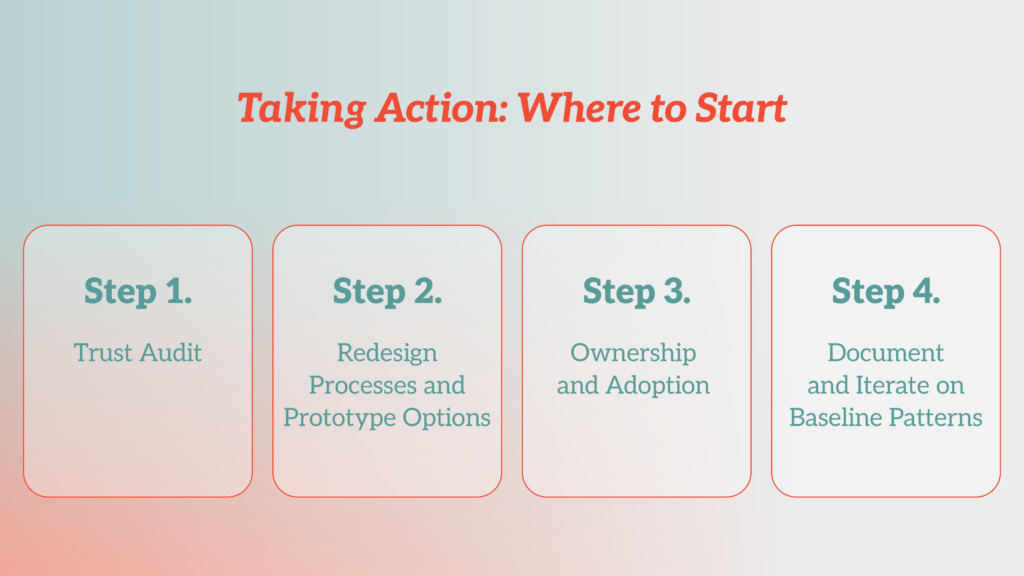
Step 1: Trust Audit
- Review your current plans or use cases for AI and evaluate the extent to which decision-making is based on assumptions versus user data.
- Conduct a real audit, including structured interviews or observation sessions with a sample of representative users, specifically including skeptics and low-adopters, to understand how AI is or isn’t being used in practice.
- Evaluate how employees, processes, and technology are being impacted by the (potential) introduction of AI and crosswalk that against a criteria set for AI applicability for business outcomes, not outputs.
- Identify where situational or dispositional trust breaks down and why.
Step 2: Redesign Processes and Prototype Options.
- Facilitate cross-functional redesign sessions that define new ways of working with AI and solution for barriers to adoption.
- Develop low-fidelity low-cost prototypes of revised tools and processes and test with user segments, using behavioral measures (e.g., correction rate, escalation sentiment) in addition to attitudinal measures.
Step 3: Ownership and Adoption
- Use audit and prototyping sessions to identify gaps in knowledge, skills, and abilities (KSAs) to adopt AI-based solutions and develop a formal approach to upskilling staff for AI adoption.
- Support education with communications and provide opportunities for low-risk experimentation with AI that supports scaling AI to new areas of the business.
Step 4: Document and Iterate on Baseline Patterns
- Build solutions and review performance over time, correlating behavior changes and operational results with AI.
- Develop measurement frameworks that can be repurposed and applied to various business units undergoing evaluations of AI suitability.
- Study EX data to identify new and emerging concerns or challenges as the role of AI evolves within the organization.
Building Trust Over Time
Trust is not static. Measuring reliance rate, correction rate, and user-reported confidence at regular intervals reveals whether the system is building trust over time or slowly losing it. A declining trust trajectory is an early warning signal that design is needed to develop a quality intervention before adoption stalls.
Organizations that extract the most value from AI over the next decade will not simply be those with the most capable technology models. They will be the ones that connect model capability to human confidence and leverage design to build effective interdependencies. Trust is not a feature to be added after the AI works. It is the condition under which the AI gets to work at all.
Interested in a trust-centered design review of your existing AI interfaces? Contact our team to explore how targeted design improvements can accelerate adoption and improve measurable outcomes across your AI program.
FAQs
Why do enterprise AI initiatives struggle with adoption?
Many AI initiatives fail because users do not trust the system enough to integrate it into their workflows. When AI outputs lack transparency or appear misaligned with human expertise, employees often revert to manual processes. Organizations that prioritize trust-centered design and human-in-the-loop workflows are more likely to achieve sustained AI adoption.
What is situational trust in AI?
Situational trust is a user’s confidence in a specific AI system for a specific task or business problem. It is influenced by transparency, reliability, task complexity, and how well the AI aligns with human judgment. Design plays a key role in determining where AI is appropriate and where human oversight should remain central.
How can UX and design improve AI adoption?
UX and design help organizations uncover the concerns, behaviors, and workflow challenges employees face when using AI. Through discovery, prototyping, and user testing, teams can identify where AI improves efficiency and where it may introduce operational or human risk. This creates AI experiences that feel more transparent, useful, and trustworthy.
What are the first steps to building trust-centered AI programs?
Organizations should start with a trust audit to understand how employees interact with AI and where trust breaks down. This includes interviews, workflow observation, and evaluating the impact of AI across people, processes, and technology. From there, teams can redesign workflows, prototype solutions, address skill gaps, and establish measurable adoption frameworks.