Key Takeaways: AI in the Software Development Lifecycle
- AI is modernizing the entire software development lifecycle, not just coding. Its role now extends across planning, development, testing, security, deployment, and operations.
- AI can turn the SDLC into a continuous intelligence loop. Insights from production, security, testing, and development can flow between lifecycle stages instead of remaining trapped within individual teams or tools.
- AI improves planning by turning requirements into actionable development work. It can identify ambiguity, uncover dependencies, generate user stories, evaluate architecture options, and help prioritize work against business goals.
- AI-enabled development modernization delivers more value than code generation alone. Developer productivity is a local improvement, while modernizing the broader development system can create lasting gains across teams and workflows.
- Testing, security, deployment, and operations become more continuous with AI. AI can generate and maintain tests, identify vulnerabilities, assess deployment risk, analyze telemetry, and accelerate root-cause analysis.
- Enterprise AI adoption requires governance and a modern engineering foundation. Modern platforms, DevSecOps automation, AI governance, observability, and an adaptable engineering culture provide the foundation for scaling AI across the SDLC.
Most of the noise about AI in software is about one thing: developers writing code faster. It is the easiest part to see and the easiest to demo, so it gets the attention. But if that is where your interest stops, you are watching the smallest wave and missing the tide behind it.
The larger enterprise opportunity is not a faster hand at the keyboard. It is applying AI across the entire way software gets delivered, from the first conversation about what to build all the way through to keeping it healthy in production. When AI shows up at every stage instead of just the coding one, something changes about the shape of the work itself. The software development lifecycle stops being a relay race where each stage hands off to the next and starts becoming something more connected, more informed, and frankly more intelligent.
That is what an AI software development lifecycle really means, and it is what this piece is about: not the code-generation headline, but what happens when AI is woven through planning, development, testing, security, deployment, and operations as one continuous system.
Embedding AI into the Agile lifecycle
Modern software delivery runs in loops, not lines. Agile, DevOps, and CI/CD replaced the old stage-by-stage handoff with short iterations, continuous feedback, and cross-functional teams that plan, build, test, secure, deploy, and operate in tight, repeating cycles. Feedback flows in every direction, and the work never really stops moving. If you build software today, this is how you already work.
What AI changes is not the shape of that cycle but the speed and intelligence running through it. The point is not to replace any stage, the people in it, or the Agile practices around it, it is to make the loops you already have faster, tighter, and better informed. Agile made feedback human-paced: A retrospective every two weeks, a dependency surfaced three sprints in, a production incident that reshapes next quarter’s plan. AI collapses that latency. A planning decision can be informed by what production is telling you right now. A security finding can flow straight back into how the next feature is written. A test suite can adapt as the code changes rather than waiting for someone to update it.
That shift, from human-paced loops to continuous, AI-empowered ones, is the real story of AI in the modern lifecycle.
Let’s walk through it stage by stage, and then talk about the thing that matters most: what happens when you connect them.
1. Planning: turning requirements into actionable development
Planning is where software succeeds or fails long before a line of code is written, and it is a surprisingly good place for AI to help. Feed it a rough set of requirements and it can pull them apart, spot the ambiguities, and ask the questions a good engineer would ask in a refinement session. It can turn a vague ask into a set of specific requirements and user stories, sketch out architecture options with the tradeoffs spelled out, and draft the documentation that usually gets written last or not at all.
The more valuable move happens a little deeper. AI can help prioritize a backlog against business goals rather than gut feel, and it can flag dependencies early, the ones that normally surface three sprints in when they are expensive to untangle. Catching those at the planning stage instead of mid-build is the kind of unglamorous win that quietly saves a quarter.
2. Development: moving beyond AI-generated code
This is the stage everyone already knows, so it is worth being precise about it. Yes, AI generates code. It also refactors it, explains it, and, maybe most usefully for an enterprise, helps a team understand legacy code that no one on the current payroll wrote. Pointing AI at a twenty-year-old module and getting back a clear account of what it does and why is a genuine superpower, and it feeds directly into modernization work that has stalled for years.
Here is the argument worth making, though. Developer productivity is important, but it is not the prize. A developer who writes code twice as fast inside an unchanged system just produces twice as much code for the same broken pipeline to choke on. The bigger opportunity is development modernization, changing how development itself works, so that AI assistance, legacy understanding, and application modernization compound into a better way of building rather than a faster version of the old way. Productivity is a local gain. Modernization is a system gain, and system gains are the ones that last.
3. Testing: making quality continuous
Ask most teams where their test coverage is thinnest and you will get an honest shrug, because the gaps live exactly where nobody thought to look. That is what AI changes about testing. It generates tests from requirements and from the code itself, then goes hunting for the paths nobody covered, the edge cases that live in the space between “what we specified” and “what we actually built.” It stands up regression suites and keeps them current as the code shifts underneath them.
The deeper effect is on timing. When tests are generated and run continuously instead of assembled in a pre-release crunch, problems surface while the change is still fresh in a developer’s head, not weeks later when fixing them means re-learning the whole thing. Quality stops being a gate you clear at the end and becomes a signal that is always on.
4. Security: bringing intelligence into DevSecOps
Security is where continuous intelligence stops being a nice-to-have and starts being the whole point, and it happens to be territory Oteemo knows well from its DevSecOps heritage. AI can identify vulnerabilities as code is written, recommend secure alternatives in the moment, and analyze the dependency tree for the transitive risks that are almost impossible to track by hand. It can watch the software supply chain and give you visibility into where your code and its ingredients actually come from.
Two things make this more than a smarter scanner. First, policy enforcement can be baked in, so the rules your organization cares about are applied automatically instead of remembered inconsistently. Second, compliance can become continuous, evidence gathered as you go rather than reconstructed in a scramble before an audit. That is DevSecOps with intelligence threaded through it, and it is a natural bridge into the kind of governed, secure delivery Oteemo builds with AXIOM.
5. Deployment: creating more intelligent delivery pipelines
Every engineer knows the particular silence of a Friday afternoon deploy. Deployment is the stage where a small mistake becomes a very public one, which is exactly why intelligence here pays off so fast. AI can automate the CI/CD steps, judge whether a release is genuinely ready rather than merely scheduled, and weigh the risk of a change based on what it touches and what history says about changes like it. It can manage environments and assist with infrastructure-as-code so the plumbing keeps pace with the application.
The piece that changes the emotional temperature is automated remediation. When a deploy goes wrong, AI can catch it and, inside the right guardrails, roll back or correct course before a blip becomes an incident. That is what turns deployment from a held-breath event into a managed, observable process, and it is what makes the Friday afternoon deploy a little less of a dare.
6. Operations: closing the development feedback loop
Production is where software meets reality, and it generates a flood of signal that most organizations barely use. AI is good at exactly this: watching observability data, making sense of logs and telemetry, investigating incidents, and driving toward root cause instead of stopping at symptoms. It can spot performance problems and suggest where to optimize.
But the point of this stage is not just faster incident response, valuable as that is. Production is generating hard truths about your software every second, what actually breaks, what actually gets slow, what users actually do, and in most organizations that knowledge dies in a dashboard nobody reads after the incident is closed. The interesting question is what happens if it doesn’t die there. What if it flows back upstream?
The real opportunity: connecting intelligence across the SDLC
Here is the thing most organizations miss. They deploy AI stage by stage, a coding assistant here, a test generator there, an anomaly detector in ops, and end up with a handful of clever tools that do not talk to each other. That is better than nothing. It is also leaving the biggest prize on the table.
The real opportunity is to let intelligence flow across the whole lifecycle:
Plan ↔ Build ↔ Test ↔ Secure ↔ Deploy ↔ Operate
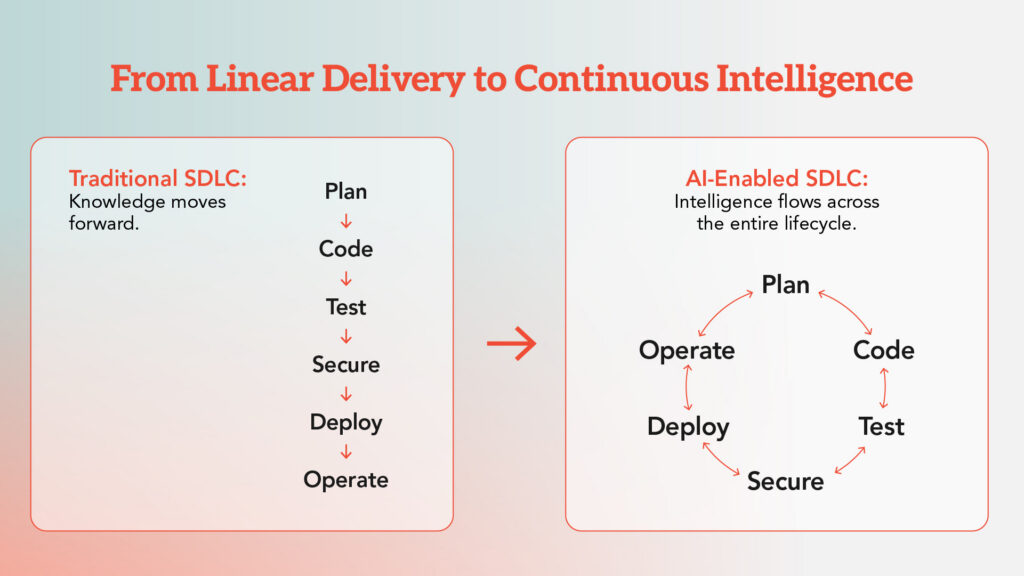
Notice the arrows point both ways. Production insights inform development. Security findings inform how code gets written. Testing results inform what gets planned next. AI is uniquely suited to connecting these feedback loops because it can read the signal at one stage and carry the meaning to another, translating a production incident into a planning input or a security finding into a coding guardrail.
Make that concrete. Say Operations flags a latency spike in a checkout service every time traffic climbs past a certain point. Without connected intelligence, that is an ops problem: someone gets paged, restarts something, closes the ticket. The lesson stays trapped in Operations. In a connected lifecycle, that same signal travels. AI correlates the spike to a specific database call introduced two releases ago, so the finding lands back in Development as a concrete refactoring target rather than a vague “make checkout faster.” It becomes a new performance test in the Testing stage, so the regression can never quietly return. It surfaces in Planning as a prioritized backlog item with the business cost attached, and it informs the next Deployment as a risk factor to watch. One production signal just rippled backward through five stages, and it did so because AI carried the meaning across the walls that normally stop it.
That is the shift. The lifecycle becomes a continuous intelligence loop rather than a set of disconnected cycles, where each trip around makes the next one smarter. A disconnected lifecycle forgets what it learns; a connected one compounds it. That is the real difference between an organization that uses AI tools and one that has genuinely modernized its lifecycle, and it is what enterprise leaders should actually be aiming for. The disconnected tools are table stakes. The connection is the advantage.
Why governance becomes more important as AI adoption grows
The more influence AI has over how software gets delivered, the more the quiet questions start to matter. And in a connected lifecycle, AI’s influence is exactly what grows. So it is worth being honest about the questions that come with that:
Who is allowed to use which models? What enterprise data are those models permitted to touch? How is AI-generated code reviewed before it ships, and by whom? When an AI takes an action, is there a record of what it did and why? How do you keep sensitive IP from leaking into a service you do not control? And where, specifically, must a human stay in the loop no matter how capable the automation gets?
None of these are reasons to slow down. They are the reasons to build on solid ground. An organization that can answer them clearly is one that can let AI do more, precisely because it knows where the boundaries are. This is where a governed AI narrative stops being abstract, the connected, intelligent lifecycle only works when it runs inside guardrails that people trust.
Building the foundation for an AI-empowered Agile lifecycle
A connected, intelligent lifecycle does not appear because you bought AI tools. It rests on a foundation, and in practice that foundation has five parts.
Modern platforms come first, because AI needs a solid, consistent system to operate within rather than a tangle of one-off environments. DevSecOps automation is next, so security and quality are continuous properties of the pipeline instead of gates bolted on at the end. Enterprise AI governance provides the answers to all those questions above, the models, the data, the oversight, the audit trail. Observability and telemetry supply the signal that makes the whole feedback loop possible; you cannot feed production intelligence back into planning if you cannot see production clearly. And finally, engineering culture and operating model, because none of this lands if the people and the way they work do not evolve with the tooling. Technology shifts are easy to buy and hard to adopt, and the adoption is the part that actually matters.
Get those five in place and AI has something worth connecting. Skip them and you get scattered tools sitting on top of a disconnected lifecycle.
From AI tools to AI-enabled development modernization
So here is the perspective worth leaving with. The goal was never to hand every developer one more AI tool. A faster keyboard is a fine thing, but it is not a transformation.
The goal is to rethink how software is planned, built, tested, secured, delivered, and operated, with AI embedded throughout the system and, crucially, connected across it. That is the move from AI tools to AI-enabled development modernization: from clever assistance at individual stages to an AI software development lifecycle that learns from itself on every pass. The organizations that make that shift will not just ship faster. They will build software that gets smarter the longer they run it.
Ready to modernize how you build software? Explore AI-enabled development modernization with Oteemo.
FAQs
What is AI in the software development lifecycle?
AI in the software development lifecycle means applying artificial intelligence across planning, development, testing, security, deployment, and operations. Rather than using AI only to generate code, an AI-enabled SDLC uses AI throughout the development process to improve decision-making, automate repetitive work, identify risks, and connect feedback between lifecycle stages.
How is AI used across the software development lifecycle?
AI can analyze requirements and dependencies during planning, generate and refactor code during development, create and maintain tests, identify security vulnerabilities, assess deployment risks, and analyze production telemetry. Connecting these capabilities allows intelligence from one stage of the SDLC to inform decisions elsewhere in the lifecycle.
How does AI improve Agile software development?
AI can make Agile development cycles faster and better informed by reducing the time between feedback and action. Production insights can inform planning, security findings can influence development, and testing can adapt as code changes. This creates more continuous feedback loops without replacing Agile practices or the people responsible for them.
What is the difference between AI-assisted coding and AI-enabled development?
AI-assisted coding focuses primarily on individual development tasks such as generating, explaining, or refactoring code. AI-enabled development takes a broader approach by integrating AI across the software delivery lifecycle. The goal is not simply to help developers write code faster, but to modernize the system through which software is planned, built, tested, secured, deployed, and operated.
How can AI improve DevSecOps?
AI can support DevSecOps by identifying vulnerabilities as code is developed, recommending secure alternatives, analyzing dependencies, monitoring the software supply chain, enforcing organizational policies, and continuously collecting compliance evidence. This helps make security and compliance continuous parts of software delivery rather than end-of-cycle gates.
What does an enterprise need before implementing AI across the SDLC?
Scaling AI across the SDLC requires more than purchasing AI tools. Enterprises need modern platforms, DevSecOps automation, AI governance, observability and telemetry, and an engineering culture and operating model capable of adopting new ways of working. These foundations allow AI capabilities to operate as part of a connected development environment rather than as isolated tools. How AI Is Modernizing the Softw…