
As organizations accelerate AI adoption, enterprise AI architecture is becoming a more important competitive differentiator than the individual models they deploy. Rather than relying on a single AI provider or allowing fragmented model decisions across teams, enterprises need a governed, flexible architecture that supports intelligent model routing, cost optimization, security, and operational visibility. The real opportunity lies in building an AI infrastructure that can adapt as models evolve without sacrificing enterprise control.
Key Takeaways
- Enterprise AI architecture matters more than choosing the best AI model. Long-term competitive advantage comes from how organizations orchestrate, govern, and manage AI models across enterprise workflows, not from committing to a single provider.
- Fragmented AI model selection creates hidden operational risks. When developers, vendors, and individual teams independently choose AI models, enterprises lose visibility into costs, security, performance, and governance.
- Intelligent model routing can improve AI cost efficiency. Matching AI models to specific workloads based on performance, complexity, and cost helps organizations optimize spending without unnecessarily relying on expensive frontier models.
- Multi-model AI architecture reduces vendor dependency. A provider-agnostic approach gives enterprises the flexibility to adopt new AI models, maintain operational resilience, and adapt as the AI landscape evolves.
- Enterprise AI governance must be built into the architecture. Centralized access controls, usage policies, observability, and cost management allow organizations to scale AI adoption while maintaining security and accountability.
- The future of enterprise AI will be decided above the model layer. Organizations that control how AI models are selected, routed, monitored, and governed will be better positioned to turn AI experimentation into sustainable business value.
Enterprise architecture is the new competitive advantage changing the AI model race
What model should you use? It’s a fair question, though the target never stops moving. But it may not be the best one. Here’s another: who in your organization is actually answering it, not in theory but in practice? Is it the developers building your apps and agents? A team lead who standardized on whatever worked last quarter? A vendor who quietly made the call for you? And how easily could you change it if you had to?
For most of us the honest answer is: not easily, and not by anyone in particular. The choice got made in a dozen small places and then quietly set in stone. That’s worth sitting with, because it’s a decision that shapes what your AI costs and whether it keeps working when a provider has a bad day.
So the loud question, which model, keeps drowning out a quieter one that actually decides the outcome: can you govern that choice, and change it when you need to? Get that part right and the model race stops being a threat. A new model ships, prices shift, a provider stumbles, and you adjust in one place, on purpose. The flexibility is the advantage. The model is just what runs through it.
You already have more than one answer
If this feels abstract, look at what’s actually running in most organizations. The average enterprise is already using several AI platforms at once. A 2026 VentureBeat Pulse Research survey of enterprises with 100 or more employees found 85% run two or more orchestration platforms, and 64% run three or more, averaging around three per organization.1 That doesn’t come from a plan. It comes from a race: over the past two years, teams rushed to adopt AI faster than anyone could coordinate, often duplicating each other or pulling in opposite directions. The tools arrived; the governance didn’t keep up. We’re still in the wild-west stage, and the map hasn’t been drawn.
So the question isn’t whether you’re multi-model. You are, three times over. The question is whether anyone is steering it, and the same research notes that cost and oversight are lagging well behind the sprawl. Three platforms isn’t three strategies. It’s usually three defaults nobody reconciled.
Where the AI model decision actually gets made
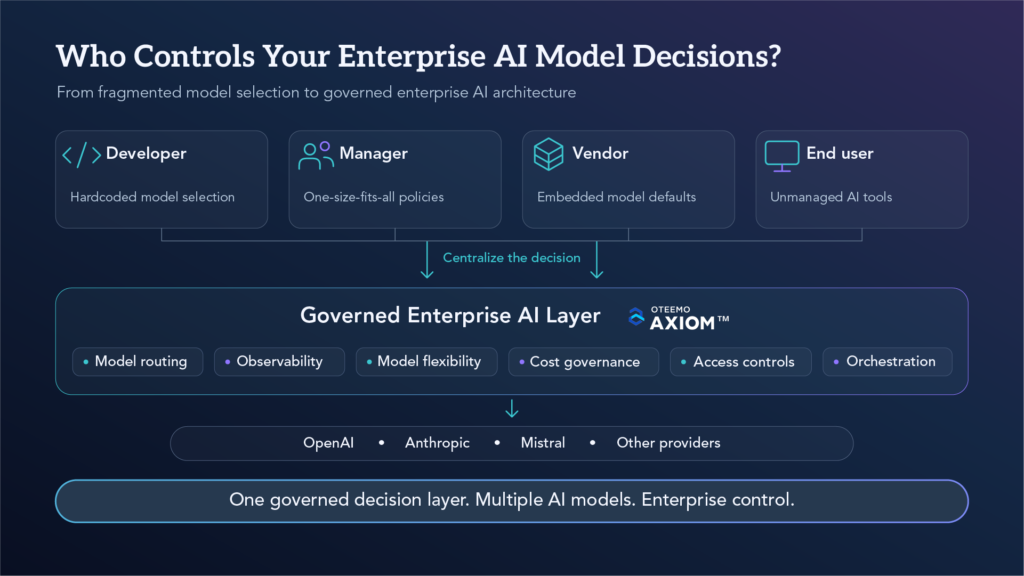
Follow the decision to where it’s really made, and you won’t find a strategy meeting. You’ll find four quieter places, and because the work got spread across teams that never compared notes, you’ll usually find all four at once.
The first is a developer. Building an agent, they write a model name into the code, chosen in the moment because it was the one they knew or the one that worked last time. If they’re experienced, they pull it into configuration so it can be changed later. If they’re rushed, it freezes into the codebase and is never revisited. The second is a manager or a policy (“we’re a Claude shop,” “we standardized on OpenAI”): a real decision, but a blunt one, applied to every workload at once with no regard for which model actually fits which task. The third is a vendor, who picked a model on your behalf for every embedded-AI feature you bought and never told you which. The fourth is the end user, who settled it personally by pasting company data into whatever was open in another tab.
None of these is the strategic decision the benchmark headlines imagine. Each is made at the bottom of the stack, under local pressure, and then left to harden. McKinsey finds that in most large organizations these AI building blocks get assembled by individual teams in an ad hoc way: undocumented, ungoverned, and invisible to the rest of the company.2 The industry keeps answering with the same advice: route every model call through a single boundary and treat the model ID as runtime configuration, not a hardcoded constant.3 The fact that the warning has to be repeated so often is the tell. This isn’t anyone doing something wrong. It’s the tooling moving faster than the coordination, which is just where a new technology sits before its governance catches up.
What the un-owned decision quietly costs
A scattered decision would matter less if every model cost about the same to run. They don’t, and the gap is far wider than the sticker price per token suggests.
Cheaper tokens don’t mean cheaper AI. Two models can finish the same task while burning very different amounts of computation, because their reasoning, context handling, and provider-side routing differ. The right unit was never cost per token; it’s cost per finished task. The clearest look at this comes from running one model family across the same benchmark suite at different capability tiers. In a controlled comparison, accepting about a five percent drop in success rate completed the identical work at up to eighteen times lower cost.4 In a separate real-world test on 275 tasks, a smaller tier reached 99.3% of the flagship’s quality at 4.2× lower cost.5
The lesson isn’t “always buy cheaper.” It’s that the trade flips with the task: a few points of quality are worth almost any price on a hard, binary-answer problem, and close to worthless on work a human edits anyway.6 Someone is making that call for every workload you run, right now. On a defaulted decision, they’re making it blind. And the bill keeps getting harder to predict as providers change behavior between versions, reasoning tokens pile up unseen, and a single agent task fans out across dozens of model calls.
From picking a AI model to owning the decision
Once you see the cost of the un-owned decision, the goal shifts. The point isn’t to pick the right model. It’s to move the decision to a layer where someone can actually own it, see it, measure it, change it.
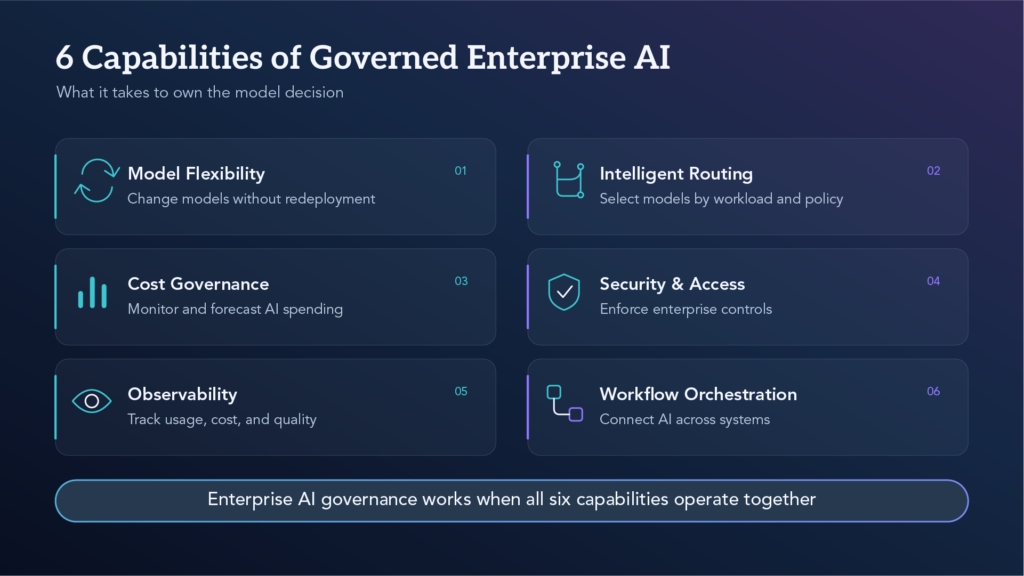
That starts with matching the model to the workload by policy rather than habit. Coding, document processing, retrieval, and complex reasoning have genuinely different needs; the choice should be governed by cost, latency, and quality, not frozen by whichever model a developer reached for first. It continues with treating resilience as a property of the layer, not the model. The market has already reached this conclusion from the vendor side: model-layer lock-in is finished as a strategy, because models commoditize in months and every serious platform now advertises model choice. The lock-in simply moved up the stack.7 When a provider goes down or a model is pulled, the organizations with the choice baked into their code wait for a rewrite; the ones routing through a governed boundary reroute and keep running. Changing models is never entirely free, of course. Providers differ in real ways,8 but a layer that owns the decision lets you weigh that tradeoff deliberately instead of discovering it after you’re locked in.
What it takes to own the decision
Owning the decision isn’t one capability. It’s a set that only works together, and whatever you choose to get there, whether you build it, buy it, or consolidate onto something you already run, it has to clear the same bar.
| Capability | What owning the decision requires |
| Model flexibility | the choice can change without a redeploy |
| Intelligent routing | the choice is made per workload, by policy |
| Cost governance | the choice’s cost is visible and forecastable |
| Security and access | the choice honors enterprise controls across every provider |
| Observability | you can see which model handled what, at what cost and quality |
| Workflow orchestration | the choice operates across systems, not tool by tool |
These have to move together because any one alone just recreates the problem in a new shape. A router with no observability still can’t tell you who decided or what it cost. Observability with no governance just gives you a clearer view of the chaos. Cost controls with no routing let you watch the bill climb with no way to act. Make cost visible before the invoice arrives; let the choice survive an outage by rerouting rather than waiting on a rewrite; carry it into the tools people actually work in rather than stopping at a chat window. One more platform that does only some of these just adds a fourth uncoordinated silo to the three you already have.
Oteemo AXIOM™ is one platform built to that spec. It puts providers (OpenAI, Anthropic including Claude via Google Vertex AI, Mistral, Groq, and other OpenAI-compatible endpoints) behind a single interface, so the choice among them is configuration. Role- and group-based access control, cascading from global defaults to role and group overrides, gives the decision an administrator rather than a default. Per-user token balances and transaction tracking surface consumption, and agents can fall back to a cheaper model to hold spend down. Because the decision lives in the layer, a provider going dark is a reroute, not a rebuild. And it carries into Slack, Microsoft Teams, Jira and Confluence, and Bitbucket, under SSO, enforced two-factor authentication, and an audit trail. Whether or not AXIOM is your answer, the bar it’s built to is the one worth measuring any option against.
The enterprise advantage was never access to the most powerful model. It’s the architecture that makes the model decision ownable, governable, and sustainable at scale.
Accident or architecture: The future of Enterprise AI will be won above the model layer
Somewhere in your organization, right now, the model decision is being made: by a config file, a policy, a vendor default, a browser tab. The frontier models will keep changing, and their relative strengths will keep shifting in ways no one can reliably predict. That unpredictability is exactly why staking your strategy on any single model, or on the model layer at all, is the wrong bet. The advantage that lasts sits above the model: in owning the decision about which one to use, who makes it, where it lives, and whether it can change when the ground moves.
So the question was never only which model is best. It’s whether that choice gets made by accident or by architecture.
References
1. Agentic orchestration: enterprise AI organizations know how to govern agents but still can’t meter what they cost. Ruberli, August 2026. Coverage of a 2026 VentureBeat Pulse Research wave on agent orchestration (n=107, organizations with 100+ employees, July 2026 fielding). Source of the 85% / 64% / 3.1-platform figures. https://ruberli.com/2026/08/12/agentic-orchestration-enterprise-ai-organizations-know-how-to-govern-agents-but-still-cant-meter-what-they-cost/ — Note: this orchestration finding is from the 107-enterprise July wave; the “573 leaders” figure cited elsewhere belongs to a different wave of the same Pulse Research series. The original VentureBeat article is gated; see pre-publication checklist item 1.
2. Fighting Tool Sprawl: The Case for AI Tool Registries. O’Reilly Radar, 2026. Summarizing a McKinsey finding on ad hoc, ungoverned AI tooling in large organizations. https://www.oreilly.com/radar/fighting-tool-sprawl-the-case-for-ai-tool-registries/
3. Build an LLM Fallback Layer Before Your Model Vanishes. The Road to Enterprise, 2026. Source of “route every model call through a single boundary and treat the model ID as runtime configuration, not a hardcoded constant.” https://theroadtoenterprise.com/blog/model-agnostic-ai-layer-fallbacks
4. LLM Parameters: GPT-5 tier analysis. AIMultiple, 2026. Controlled comparison across one model family at different capability tiers; ~5% quality drop at up to 18× lower cost. https://aimultiple.com/llm-parameters
5. GPT-5 benchmark. Wolfia, 2026. Real-world test on 275 tasks; smaller tier reached 99.3% of flagship quality at 4.2× lower cost. https://wolfia.com/blog/gpt-5-benchmark-showdown
6. Reasoning Effort: Cost vs. Quality Benchmarks 2026. Digital Applied, 2026. Cost-per-correct-answer framing; the quality-vs-cost trade flips by task type. https://www.digitalapplied.com/blog/reasoning-effort-cost-vs-quality-benchmarks-2026
7. The AI Agent Harness: Where Vendor Lock-In Went After the Model Became Swappable. Kai Waehner, September 2026. Argues model-layer lock-in is finished and the lock-in moved up the stack. https://www.kai-waehner.de/blog/2026/09/01/the-ai-agent-harness-where-vendor-lock-in-went-after-the-model-became-swappable/
8. The Abstraction Layer That Made Every Model Mediocre. Tian Pan, July 2026. Thin provider abstractions deliver portability by flattening to the shared feature set. https://tianpan.co/blog/2026/07/02/the-abstraction-layer-that-made-every-model-mediocre