
Key Takeaways: Enterprise AI and Non-Determinism
- Enterprise AI is inherently non-deterministic. Generative AI can produce different outputs from the same inputs because models, context, retrieval, reasoning paths, and agent decisions can vary. Enterprise architecture needs to be designed around that reality rather than assuming predictable behavior.
- Non-determinism is not necessarily a flaw. The variability of AI allows systems to identify correlations, anomalies, patterns, and solutions that deterministic software may never have been explicitly programmed to find.
- Not every enterprise task should be routed through an AI model. Tasks with fixed rules, known calculations, or repeatable answers should remain deterministic, while AI should be used where judgment, synthesis, reasoning, or correlation creates value.
- AI architecture should control the environment rather than every output. Identity, permissions, model governance, tool boundaries, human escalation, observability, audit trails, and runtime policies can create guardrails around probabilistic AI without eliminating its flexibility.
- Agentic AI makes non-determinism more consequential. AI agents introduce multiple decision points as they reason, retrieve information, select tools, take actions, and respond to results, increasing both the potential value and risk of non-deterministic behavior.
- Enterprise AI needs a control plane for bounded non-determinism. Organizations need a consistent architectural layer for policy, identity, permissions, observability, auditability, cost controls, agent boundaries, and routing between deterministic systems and probabilistic AI.
For decades, enterprise software has been built around a simple expectation: given the same inputs and the same rules, a system produces the same output. Predictability wasn’t just a nice property. It was the foundation everything else was built on. Testing, auditing, compliance, even the way we think about “correctness,” all assume a system’s behavior is repeatable.
Generative AI breaks that assumption. The same prompt can produce different outputs. Models change. Context changes. Agents make decisions dynamically, in the moment, based on what they’re seeing. Once these systems become part of real enterprise workflows, non-determinism stops being a curious technical footnote. It becomes an architectural question every serious organization has to answer.
Most of the conversation around these treats non-determinism as a problem to be minimized, as noise to be engineered out of the system until AI behaves more like the deterministic software it’s replacing. We think that instinct is wrong, and it leads to the wrong architecture.
Non-determinism isn’t a bug. It’s how AI finds things you didn’t know to look for.
Non-determinism shows up for a lot of reasons: probabilistic outputs, differences between model versions, variability in retrieved context, which tool an agent decides to call, the path a multi-step reasoning chain takes to an answer. It’s easy to look at that list and see a reliability problem.
But that same variability is what allows AI to surface correlations that a predefined, deterministic evaluation of the data would never find in the first place. A rules engine can only find what it was told to look for. A fixed query can only return what was written to return. Non-deterministic reasoning is what lets a system notice that two seemingly unrelated support tickets share a root cause, or that a pattern in procurement data resembles one from an unrelated project three years ago, or that an anomaly in the logs is worth flagging even though no rule was written to catch it.
That’s not a side effect of imprecision. It’s the actual value of using AI over traditional software in the first place. Architect the variability away entirely, and what’s left is predictable, sure, but no more useful than the deterministic tooling you already had.
The goal isn’t to eliminate non-determinism. It’s to know where you want it, and to build an architecture that gives it room to work.
Why non-determinism becomes an enterprise architecture problem
A chatbot that phrases an answer in two different ways is low consequence. The stakes change entirely once AI systems are doing more than talking, once they can query enterprise data, generate code, trigger workflows, interact with infrastructure, invoke APIs, and take action on your behalf.
The more authority an AI system has, the more consequential its variability becomes. That’s true whether the variability is a problem, like an agent picking an unexpected tool at the wrong moment, or an asset, like an agent surfacing a correlation nobody asked it to look for. Either way, it demands an architecture actually designed for it, not one inherited from deterministic software and patched to tolerate AI as an exception.
Not every problem should go through the model
This is where a lot of enterprise AI architecture gets it backwards. Once teams have an LLM that can reason its way through almost anything, the temptation is to route everything through it, including problems that already have a single, correct, repeatable answer.
If a calculation has a hard algorithm, if a lookup has a defined answer, if a compliance check is a fixed rule against a fixed dataset, that work belongs in deterministic code, not in a model call. Routing it through an LLM instead means paying token costs for a probabilistic pass at a problem that didn’t need one, introducing variability where none is wanted, and making something harder to audit that used to be trivial to verify.
This isn’t just a cost optimization. It’s a governance decision, and it’s arguably the first one your architecture needs to make. Every request coming into an AI-enabled system should be run against a basic question: does this need judgment, synthesis, or correlation, or does it need a repeatable, deterministic answer? The first kind is what you want the model doing. The second kind should never touch it.
Get that routing right and something important happens. You stop spending tokens on the model’s non-determinism when tasks don’t need it, and you free up the compute, latency, and architectural trust budget for the problems where non-determinism is actually the point: the correlations, the synthesis, the judgment calls a fixed system was never going to make.
Traditional software controls aren’t enough for what’s left
Even after you’ve routed the deterministic work away from the model, what remains is still genuinely probabilistic, and that’s by design. Traditional controls like unit testing, integration testing, access controls, and predefined workflows are still necessary. They just aren’t sufficient on their own anymore.
AI introduces a layer of uncertainty that traditional QA wasn’t built to catch, because it isn’t testing for a wrong answer. It’s operating in a space where there’s no single right answer to test against. That calls for an additional layer: evaluation, observability, policy, identity, and human oversight, built specifically for probabilistic systems rather than borrowed from deterministic ones.
Stop trying to control every output. Control the operating environment, and protect its room to work.
This is the core of the argument: enterprise architecture shouldn’t depend on the model always producing the “right” response. It should control what surrounds the model, on both sides.
On one side, that means boundaries:
- What can the AI access? Identity and permissions.
- What can it do? Tool and action boundaries.
- Which models can it use? Model governance.
- What happens when confidence is low? Escalation and human intervention.
- Can we understand what happened? Observability and audit trails.
- Can policies be enforced consistently? Runtime governance.
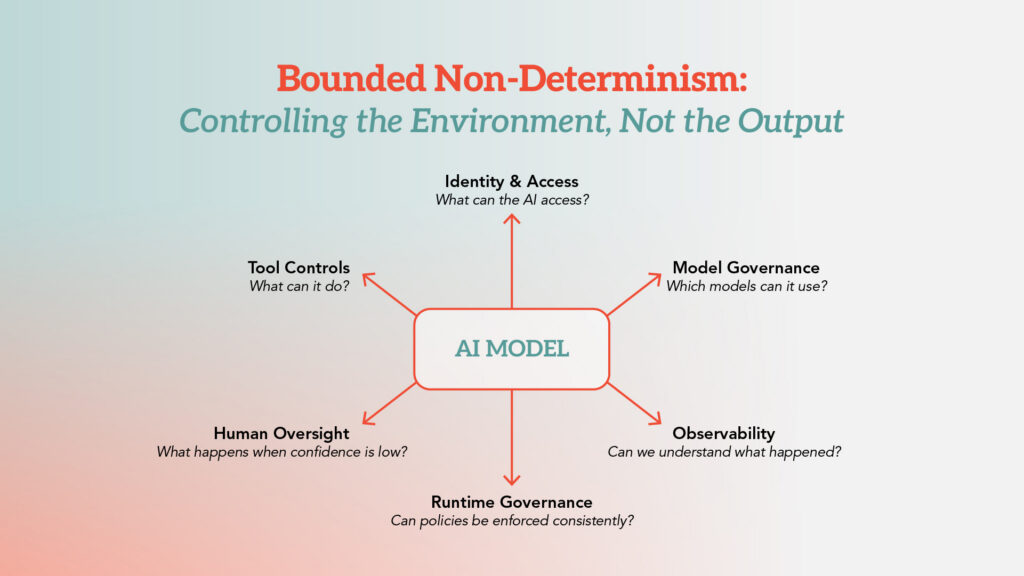
On the other side, that means deliberately preserving space for the model to do what it’s actually good at. Draw every boundary to minimize variability instead of to make it safe, and you end up with a system so constrained it can’t produce the correlations and creative solutions that justified using AI in the first place. The architecture has to protect flexibility as intentionally as it constrains it: guardrails around the reasoning, not a cage around it.
That’s the real architectural objective. Call it bounded non-determinism: not variability eliminated, and not variability left unmanaged, but variability given a clearly defined space to operate in, with the routing decisions already made about where it belongs.
Agents make this significantly more important
An LLM producing a variable response is one thing. An agent dynamically deciding to reason, select a tool, retrieve data, act, observe the result, and act again is something else entirely.
Each additional decision point is another place where behavior can diverge, and done right, another place where the system can notice something a fixed workflow would have missed. Multi-step agentic behavior doesn’t just multiply the risk of non-determinism. It multiplies the opportunity in it, too. That cuts both ways, which is exactly why the routing question (what goes through the model versus what goes through deterministic code) has to happen at every step of an agent’s reasoning chain, not just at the front door of the system.
Enterprise AI needs a control plane
None of this works as a set of ad hoc decisions made project by project. Organizations need an architectural layer sitting between fast-moving AI capabilities and critical enterprise systems, one that handles model controls, policy enforcement, identity, permissions, observability, auditability, cost controls, agent boundaries, and the routing logic that decides what’s deterministic and what isn’t.
That’s the philosophy behind Oteemo AXIOM as a governance engine. Not a layer that tries to make AI predictable, but one that makes probabilistic AI safe, observable, and accountable at enterprise scale, while still routing the right work to deterministic systems and leaving the model room to do what only it can do.
Design for variability, govern for outcomes
The question enterprise AI leaders should be asking isn’t “how do we make AI completely predictable?” That question leads to architectures that quietly strip out the exact capability that made AI worth adopting.
The better question is: how do we build an environment where probabilistic systems can operate safely, securely, and accountably, while still being free to find what a deterministic system never could?
Non-determinism isn’t going away. It’s not a defect to be patched out of enterprise AI. It’s a capability that has to be routed, bounded, and governed. An enterprise architecture that treats it that way will get more value out of AI than one that spends its energy trying to make AI behave like the software it’s replacing.