Most organizations deploying autonomous AI agents are measuring them the wrong way. They’re applying the same frameworks built for chatbots, RPA tools, and productivity software to a fundamentally different class of technology, and then wondering why the numbers don’t tell a compelling story.
Traditional metrics measure inputs and activities. Agentic AI demands metrics that measure outcomes, quality, and business impact. Getting this right isn’t a reporting exercise. It’s the difference between AI investments that earn continued funding and expansions versus pilots that stall because leadership can’t see the value.
This article presents a practical measurement framework for enterprise leaders who need to evaluate, communicate, and continuously improve the performance of autonomous AI agents in production.
Key Takeaways:
- Activity metrics like time saved and prompts per user are insufficient for agentic AI evaluation
- The right framework measures outcomes at three levels: operational, business impact, and strategic
- Agent quality and reliability metrics are as important as efficiency metrics
- Measurement architecture must be designed before deployment, not retrofitted afterward
- The goal of measurement is not just reporting but driving better decisions about where to expand, optimize, or pull back
Understanding the Measurement Gap
Why Traditional Metrics Fall Short
The metrics that dominated the copilot era were designed for a specific context: a human using an AI tool to do their job faster. In that context, measuring time saved per task, adoption rate, and user satisfaction makes sense. The human is the unit of analysis. The AI is an instrument.
Autonomous agents flip this relationship. The agent is the unit of analysis. It owns the workflow, makes decisions, calls tools, handles exceptions, and produces outcomes. Measuring it like a productivity tool is like measuring a factory by asking workers how much they enjoy the new equipment. The question isn’t wrong; it’s just measuring the wrong thing.
The most common measurement failures in agentic AI deployments follow a predictable pattern:
Organizations measure what is easy to measure rather than what matters. Task completion counts are easy to pull. Whether those completions met quality standards, drove business outcomes, or required costly human corrections is harder to quantify but far more important.
Organizations measure activity at the wrong level of abstraction. An agent processing 500 invoices is an activity. An agent reducing accounts payable cycle time by 40 percent while maintaining a 99.2 percent accuracy rate is a business outcome. Both describe the same deployment. Only one informs a resource allocation decision.
Organizations fail to measure failure modes. Tracking successes without tracking how, when, and why agents fail creates a distorted picture that eventually collides with operational reality.
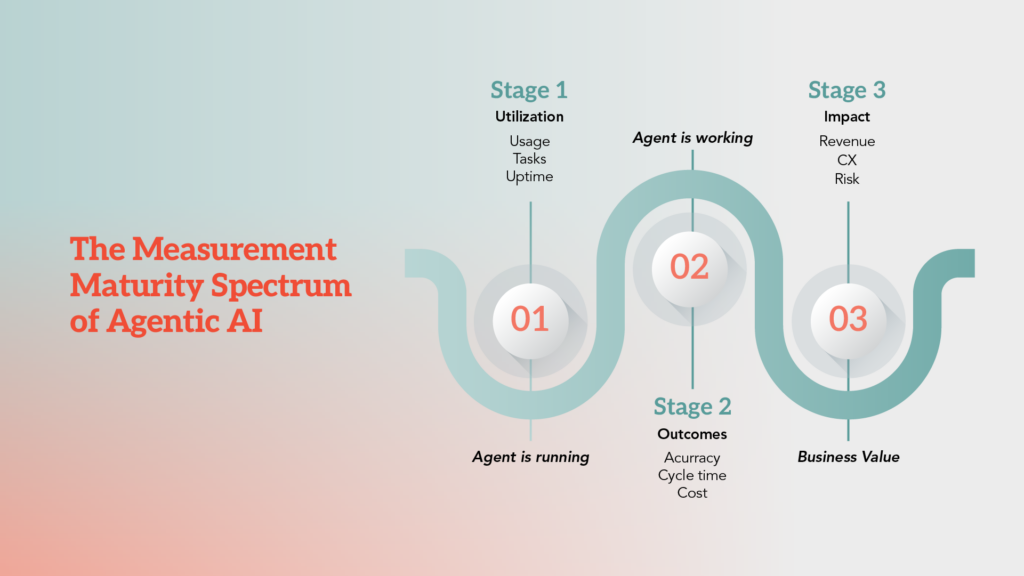
The Measurement Maturity Spectrum
Organizations tend to evolve through three stages of measurement maturity as their agentic AI programs develop:
Stage 1: Utilization Tracking. How often is the agent being used? How many tasks has it processed? What is the uptime? These metrics are necessary but not sufficient. They tell you the agent is running. They don’t tell you whether it’s working.
Stage 2: Outcome Measurement. What did the agent actually produce? Was the output accurate? How did it compare to the baseline process? Did it reduce cycle time and cost? This is where measurement starts generating decisions.
Stage 3: Strategic Impact Attribution. How is agentic AI affecting the metrics that matter to the business, including revenue, customer experience, risk exposure, and competitive positioning? This is where AI investments earn institutional support and budget authority.
Most organizations are stuck at Stage 1. The framework below is designed to move them to Stage 2 and beyond.
Core Capabilities Required for Effective Measurement
Before discussing the metrics themselves, it is worth addressing the infrastructure required to collect them reliably. Many organizations discover late in a deployment that they cannot measure what they intended to because the architecture wasn’t built for observability.
Audit Logging at the Action Level
Every action an agent takes, every tool it calls, every decision it makes, and every escalation it triggers should be logged with sufficient context to reconstruct the agent’s reasoning. This isn’t just good measurement practice. It is the foundation of trust, governance, and continuous improvement.
Baseline Documentation Before Deployment
The most common measurement regret in agentic AI is failing to establish a rigorous pre-deployment baseline. Without knowing what the process cost, how long it took, and what the error rate was before the agent, post-deployment comparisons are directional at best and contested at worst.
Human Review Capture
When humans intervene in an agentic workflow, whether to correct an error, override a decision, or handle an escalation, that intervention should be recorded with context. Over time, this data reveals the agent’s true autonomy rate and identifies the most valuable areas for improvement.
Integration with Business Systems of Record
Agent metrics that live only in an AI platform dashboard are invisible to the financial, operational, and executive stakeholders who make investment decisions. Effective measurement pipes agentic performance data into the business intelligence and reporting systems where leaders actually work.
The Measurement Framework: Three Tiers That Drive Decisions
Tier 1: Operational Metrics
Operational metrics measure agent performance at the task and workflow level, monitored daily by implementation teams and weekly by operations leaders.
- Autonomous completion rate: The percentage of workflows completed without human intervention, and the single most important operational metric.
- Task accuracy and quality rate: The percentage of completed tasks meeting defined quality standards, tracked separately from completion rate.
- Cycle time end-to-end: Elapsed time from workflow initiation to outcome delivery, measured at the full process level.
- Exception and escalation rate: The percentage of workflows requiring human intervention, which should decline over time as the agent matures.
- Cost per unit of work: The fully loaded cost to process one unit of work, benchmarked against pre-deployment costs and tracked as volume scales.
Tier 2: Business Impact Metrics
Business impact metrics connect agent performance to outcomes that appear on financial reports and leadership dashboards, reviewed monthly by operational leaders and quarterly by executives.
- Revenue cycle acceleration: The change in time from workflow initiation to revenue recognition for revenue-generating processes.
- Capacity expansion without proportional headcount: The ratio of work processed to headcount over time, capturing throughput growth without team growth.
- Error-driven cost reduction: The downstream cost of errors, including rework, remediation, and penalties, and how agents are reducing that cost pool.
- Employee redeployment value: Where human capacity is being redirected as agents absorb routine work.
- SLA and customer experience impact: Changes in response time, resolution rate, and satisfaction scores for customer-facing workflows.
Tier 3: Strategic and Risk Metrics
Strategic metrics evaluate the long-term health and trajectory of an agentic AI program, reviewed quarterly and annually to inform investment decisions.
- Program expansion velocity: How quickly the organization is identifying, scoping, and deploying new agentic use cases.
- Governance and compliance posture: The frequency and severity of compliance exceptions and audit findings attributed to agentic workflows.
- Human-AI trust calibration: Whether human reviewers are appropriately calibrated to agent performance, avoiding both overtrust and undertrust.
- Total cost of AI ownership trajectory: The full program cost tracked against value delivered, which should show improving unit economics as the program matures.
Measuring Agentic AI: Common Measurement Mistakes and How to Avoid Them
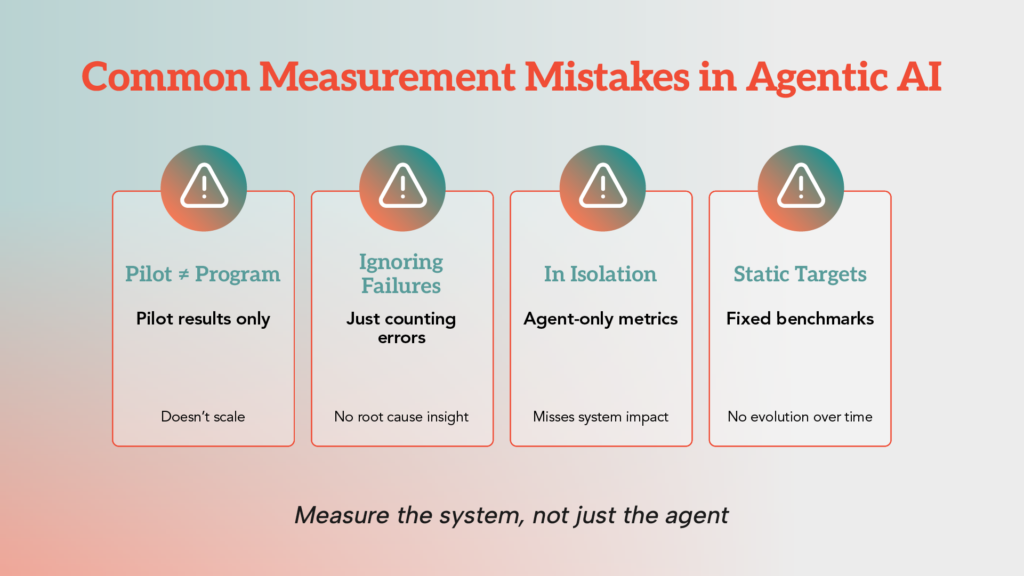
Mistake 1: Measuring the Pilot, Not the Program
Pilots are designed to succeed. They get the best use cases, the most attention, and the most favorable conditions. Organizations that measure only their pilots and present those numbers as representative of agentic AI performance are setting themselves up for disappointment when they scale. Build a measurement framework that scales with the program, not one designed to validate the initial deployment.
Mistake 2: Ignoring Failure Taxonomy
Knowing that an agent failed 8 percent of the time is useful. Knowing that 60 percent of those failures were caused by a single edge case that could be addressed with one additional tool integration is actionable. Invest in categorizing and understanding failure modes, not just counting them.
Mistake 3: Measuring Agents in Isolation
Agentic AI rarely operates in a vacuum. It changes the work of the humans around it, the load on the systems it integrates with, and the experience of the customers or stakeholders it serves. Measurement frameworks that capture only what the agent does, without capturing what changes as a result, tell an incomplete story.
Mistake 4: Setting Static Targets
A 90 percent autonomous completion rate may be an excellent result in month one and an unacceptable result in month twelve. Set targets that evolve with the program’s maturity, and create mechanisms for regularly revisiting what “good” looks like as the agent’s capabilities and scope expand.
Building Your Measurement Architecture
Before Deployment
Document the baseline process with enough precision to support future comparison. Capture cycle time, cost per unit, error rate, headcount involved, and volume processed. Identify the five to ten metrics most relevant to your specific use case and confirm you have the data infrastructure to collect them automatically.
At Deployment
Instrument the agent from day one with action-level logging and human intervention capture. Establish a review cadence: daily for operational metrics, weekly for trend review, monthly for business impact assessment. Assign clear ownership for each metric tier.
Post-Deployment Optimization
Use measurement data to drive a continuous improvement cycle. Exception categorization should feed agent retraining or scope adjustment. Accuracy trends should trigger quality reviews. Cost trajectory should inform infrastructure and integration investment decisions.
The organizations getting the most from agentic AI are not the ones with the most sophisticated models. They are the ones with the tightest feedback loops between measurement data and operational decisions.
Measurement as Competitive Infrastructure
As agentic AI programs mature, measurement will evolve from a reporting function into a competitive differentiator. Organizations that build rich, longitudinal data sets on agent performance will be able to make deployment decisions faster, with more confidence, and with more predictable outcomes than peers starting from scratch with each new use case.
The measurement frameworks being built today will also become the foundation for more sophisticated governance as agent autonomy expands. Regulators, auditors, and boards are increasingly asking organizations to demonstrate not just that AI is being used, but that its performance and risk profile are understood, monitored, and managed. A mature measurement architecture answers those questions before they become urgent.
The organizations that will lead in agentic AI over the next three to five years will not necessarily be the ones that deploy first. They will be the ones that learn fastest. Measurement is the mechanism through which learning happens at scale. Building the right framework is not an overhead cost on your agentic AI program. It is the strategic investment that makes every subsequent deployment faster, smarter, and more defensible.
Want to see how leading organizations are structuring their agentic AI measurement programs? Contact our team to discuss a custom KPI framework for your specific use cases and industry context.