Key takeaways:
- Enterprise object store solutions are the foundation of agentic AI workflows
Agentic systems generate continuous streams of unstructured data including embeddings, logs, and intermediate outputs, requiring scalable object storage to support persistence and retrieval. - Object storage enables scalable, distributed AI architectures
Unlike traditional databases, object stores support high-volume, unstructured data across distributed systems, making them essential for multi-agent coordination and AI pipeline orchestration. - Performance and throughput directly impact AI workflow efficiency
High-throughput object storage allows faster model training, real-time inference, and seamless data access across Kubernetes and cloud-native environments. - Enterprise-grade security and governance are non-negotiable
AI workloads often operate in regulated environments, requiring encryption, role-based access control, audit logging, and policy-driven data lifecycle management. - Modern AI infrastructure requires integrated, not siloed, storage strategies
Object storage must integrate with orchestration frameworks, vector databases, and DevSecOps pipelines to support scalable, secure, and production-ready agentic AI systems, aligning with a broader integrated innovation approach.
Enterprise Object Store Solutions & Agentic AI
Agentic AI systems are rapidly transforming enterprise software. Unlike traditional AI applications that respond to prompts or perform isolated predictions, agentic systems operate autonomously. They coordinate tasks, interact with tools, retrieve external knowledge, and maintain memory across complex workflows.
This shift introduces a new infrastructure challenge. Agentic AI generates and consumes massive volumes of unstructured data. Prompt logs, embeddings, intermediate outputs, workflow states, model artifacts, and training datasets all accumulate rapidly as AI agents interact with systems and data sources.
To support these workloads, organizations need storage infrastructure capable of scaling far beyond traditional databases. This is where enterprise object storage becomes foundational.
Object Stores For Modern AI Architecture
Object stores provide the scalable, resilient foundation required for modern AI architectures. When designed correctly, they enable enterprises to store and retrieve the large volumes of artifacts generated by agentic workflows while maintaining security, governance, and performance.
In this guide, we explore the role of object storage in agentic AI architectures, examine enterprise storage platforms, and outline best practices for building scalable AI data infrastructure.
The Rise of Agentic AI Systems
Agentic AI represents a new generation of intelligent software systems. Instead of simply answering questions, these systems perform actions. AI agents can break down tasks into subtasks, call APIs, retrieve information, and collaborate with other agents.
Examples of agentic systems include:
- autonomous research agents
- enterprise copilots
- automated cybersecurity response agents
- AI-driven workflow orchestration systems
- intelligent supply chain optimization agents
These systems rely on continuous interaction with data. As agents perform tasks, they generate intermediate outputs, reasoning traces, and artifacts that must be stored and retrieved across workflows.
Unlike traditional applications where data flows through predictable pipelines, agentic AI creates dynamic and evolving data patterns. Agents may retrieve documents, store embeddings, generate outputs, and update memory structures in real time.
As a result, the storage layer must support:
- high volume unstructured data
- distributed access across services
- persistent memory for AI agents
- scalable storage for training and inference artifacts
This is precisely the problem space where object storage excels.
Why Object Storage Powers Agentic AI Workflows
Object storage is designed to handle large volumes of unstructured data across distributed systems. Instead of organizing information into rows and columns like relational databases, object storage manages data as objects that contain the data itself, metadata, and a unique identifier.
This design allows object stores to scale nearly infinitely while maintaining durability and accessibility.
For agentic AI systems, this architecture offers several advantages.
First, object storage supports extremely large datasets. AI models rely on vast collections of documents, images, code repositories, logs, and training artifacts. Object stores can scale to petabytes or even exabytes of data without the performance constraints associated with traditional storage systems.
Second, object storage integrates well with modern cloud-native architectures. AI workloads often run on Kubernetes clusters, serverless compute environments, or distributed GPU infrastructure. Object stores provide API-based access that integrates seamlessly with these environments.
Third, object storage enables efficient retrieval of unstructured artifacts. AI pipelines frequently store and retrieve intermediate files, model checkpoints, prompt histories, and embeddings. Object stores make these artifacts accessible across distributed workflows.
Finally, object storage provides strong durability guarantees. Enterprise AI systems cannot afford to lose critical data such as model training datasets or workflow artifacts. Object stores replicate data across multiple nodes or regions to ensure resilience.
Together, these capabilities make object storage the foundation of modern AI infrastructure.
Enterprise Requirements for AI Object Storage
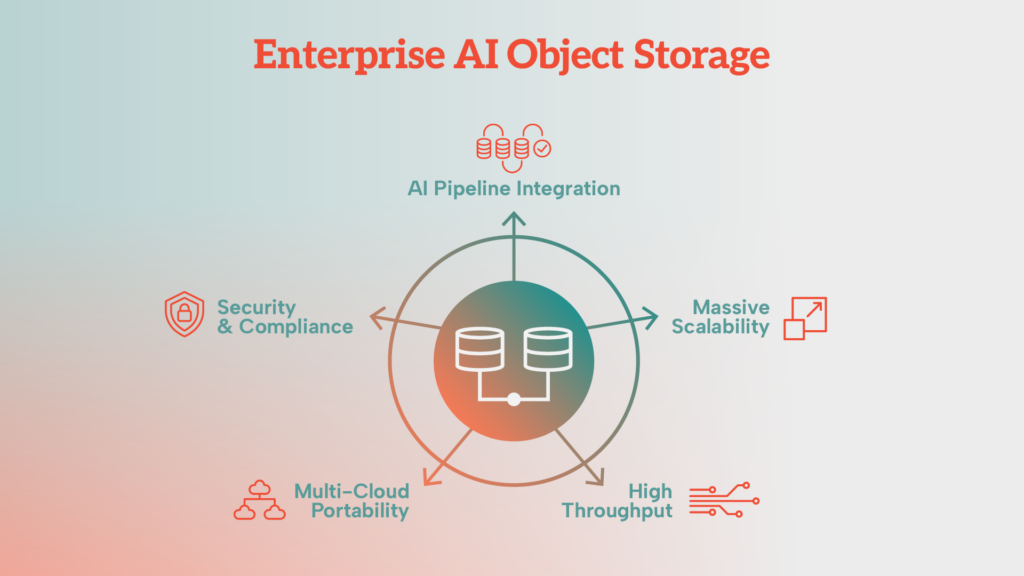
Not all object storage platforms are equal. When designing infrastructure for agentic AI workflows, enterprises must evaluate several key capabilities.
Massive Scalability
Agentic systems continuously generate data as they execute tasks. This includes prompt logs, vector embeddings, training datasets, model outputs, and operational telemetry.
Enterprise storage systems must support massive scalability while maintaining consistent performance.
Object stores designed for AI workloads often support horizontal scaling across thousands of nodes, enabling storage capacity to grow seamlessly as data volumes expand.
High Throughput Data Access
AI pipelines often require high-throughput access to large datasets. Model training, inference pipelines, and retrieval systems must read and write data rapidly.
Storage systems that support parallel access across distributed compute clusters enable faster AI workloads and reduce bottlenecks during training and inference.
Multi-Cloud Portability
Many organizations operate hybrid or multi-cloud environments. AI infrastructure must work across public clouds, private clouds, and on-premise data centers.
Enterprise object storage platforms should support deployment across multiple environments without creating vendor lock-in.
Security and Compliance
Enterprise AI systems frequently operate in regulated environments. Industries such as healthcare, finance, and defense require strict access controls, encryption, and compliance frameworks.
Object storage systems must support features such as role-based access control, encryption at rest and in transit, audit logging, and policy-based data governance.
Integration with AI Pipelines
AI infrastructure involves multiple layers including model training pipelines, vector databases, orchestration frameworks, and observability platforms.
Object storage should integrate seamlessly with tools such as:
- Kubernetes
- MLOps platforms
- data engineering pipelines
- AI orchestration frameworks
- data lakes and analytics systems
These integrations ensure that data flows efficiently across the AI lifecycle.
Reference Architecture for Agentic AI Storage
A typical enterprise agentic AI architecture includes multiple layers that work together to manage data, models, and workflows.
At the top layer are AI agents and orchestration frameworks. These systems coordinate tasks and interact with data sources.
Below the orchestration layer are memory systems and vector databases that store embeddings used for retrieval augmented generation.
Underneath these components lies the object storage layer. This layer stores unstructured artifacts such as documents, logs, model outputs, and datasets.
At the base of the architecture is the data lake or archival layer used for long-term storage and analytics.
The architecture can be visualized as:
Agent Framework Layer
AI orchestration and autonomous agents
Memory and Retrieval Layer
Vector databases and knowledge stores
Object Storage Layer
Datasets, artifacts, model outputs
Data Lake and Archive Layer
Long-term storage and analytics
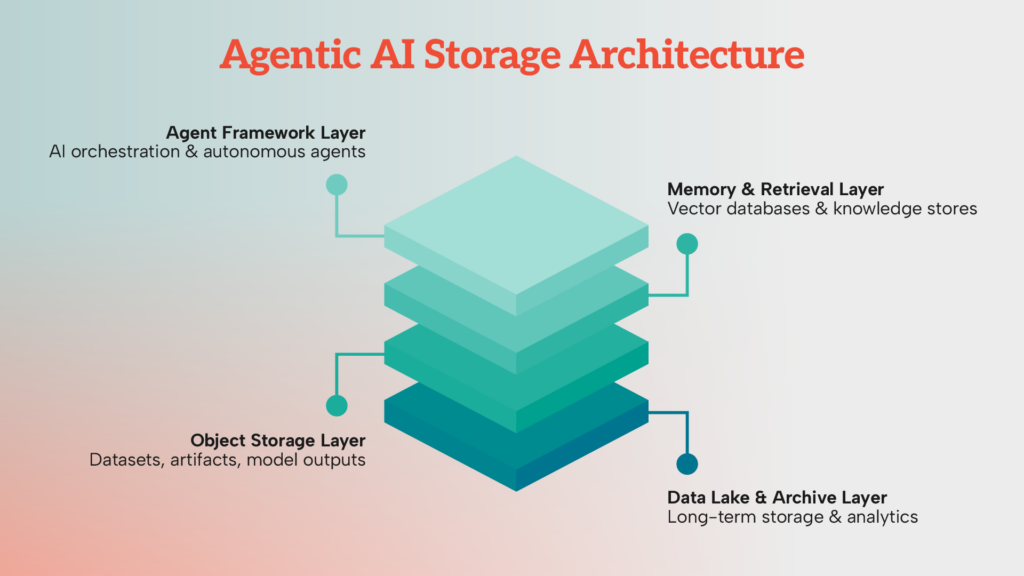
This layered architecture allows enterprises to scale AI workloads while maintaining clear separation between data types and storage systems.
The table below outlines the core layers typically found in enterprise agentic AI architectures and the role each plays in supporting scalable AI systems.
| Architecture Layer | Purpose | Example Technologies | How It Interacts with Object Storage |
| Agent Framework Layer | Coordinates autonomous agents that execute tasks, interact with tools, and manage workflows | LangChain, AutoGen, CrewAI, Semantic Kernel | Agents store outputs, logs, and intermediate artifacts in object storage |
| Orchestration & Workflow Layer | Manages task sequencing, tool invocation, and workflow execution across AI systems | Airflow, Prefect, Temporal, Kubernetes workflows | Workflow systems store execution artifacts, logs, and outputs in object storage |
| Memory & Retrieval Layer | Maintains contextual memory and knowledge retrieval for agents | Vector databases such as Pinecone, Weaviate, pgvector | Source documents and embeddings datasets are typically stored in object storage |
| Model & Inference Layer | Executes machine learning models and LLM inference workloads | TensorFlow Serving, PyTorch, Hugging Face, Ray | Models, checkpoints, and inference outputs are stored in object storage |
| Object Storage Layer | Provides scalable storage for unstructured data artifacts generated by AI systems | Amazon S3, MinIO, Azure Blob Storage, Google Cloud Storage | Serves as the persistent data backbone for AI artifacts and datasets |
| Data Lake & Analytics Layer | Supports long-term storage, analytics, and data processing for AI training and evaluation | Snowflake, Databricks, BigQuery, Apache Spark | Pulls datasets and artifacts from object storage for analysis and model training |
| Observability & Monitoring Layer | Tracks AI system performance, agent behavior, and model outputs | Prometheus, Grafana, OpenTelemetry, ML observability platforms | Logs, telemetry, and evaluation datasets are stored and retrieved from object storage |
Why This Architecture Matters
This layered architecture allows enterprises to scale AI workloads while maintaining separation between data processing, orchestration, and storage.
Object storage sits at the center of this design because it provides the durability, scalability, and accessibility required for AI systems that continuously generate new artifacts.
By combining object storage with vector databases, orchestration frameworks, and analytics platforms, organizations can build AI infrastructures capable of supporting complex agentic workflows across distributed environments.
Enterprise Object Storage Platforms for AI
Several enterprise platforms provide object storage capabilities suitable for AI workloads.
Amazon S3
Amazon S3 is one of the most widely used object storage platforms in the world. It offers virtually unlimited scalability and integrates deeply with AWS AI services such as SageMaker.
S3 is particularly well suited for cloud-native AI applications that operate entirely within the AWS ecosystem.
MinIO
MinIO is a high-performance object storage platform designed for cloud-native environments. It can be deployed on-premise or in private cloud infrastructure and is often used for AI workloads that require high-throughput access to datasets.
Organizations deploying AI clusters in private infrastructure frequently use MinIO to store model artifacts and training data.
Azure Blob Storage
Azure Blob Storage integrates closely with Microsoft’s cloud ecosystem and AI platforms. It supports enterprise governance features and is commonly used in organizations that rely on Azure for data analytics and machine learning.
Google Cloud Storage
Google Cloud Storage is optimized for large-scale analytics and machine learning workloads. It integrates directly with Google’s Vertex AI platform and other data processing services.
VAST Data
VAST Data offers high-performance storage platforms designed for AI and high-performance computing environments. Its architecture is optimized for large AI training clusters and GPU workloads.
Each of these platforms supports enterprise AI workloads, but the best choice depends on infrastructure strategy, cloud providers, and performance requirements.
Scalable Object Storage for Agentic AI with Oteemo and MinIO
Oteemo partners with MinIO to deliver high-performance, enterprise-grade object storage solutions purpose-built for modern AI workloads. MinIO’s software-defined, Kubernetes-native architecture aligns directly with the demands of agentic AI systems, where low-latency access to massive unstructured datasets is critical for real-time inference and multi-agent coordination. As a 100% S3-compatible platform, MinIO allows organizations to remain cloud-agnostic while maintaining seamless interoperability with existing S3-based tools and ecosystems. By combining MinIO’s scalable object storage with Oteemo’s expertise in platform engineering, DevSecOps, and secure cloud-native architectures, organizations can deploy portable, high-throughput storage layers that support AI pipelines across hybrid and regulated environments. This joint approach enables enterprises to operationalize agentic AI workflows with the performance, security, and flexibility required at scale.
Discover more about MinIO by visiting their website here.
Storage Patterns for Agentic AI Workflows
Agentic AI systems generate a variety of data artifacts throughout their lifecycle. Understanding common storage patterns helps organizations design scalable architectures.
1. AI Artifact Storage
Agents continuously generate outputs during task execution. These outputs may include prompt logs, reasoning traces, intermediate files, and generated content.
Object storage provides a scalable location to persist these artifacts for auditing, debugging, and analytics.
2. Model Training Pipelines
Training large AI models requires access to massive datasets. Object storage enables distributed training pipelines to access data across clusters without replicating files across multiple nodes.
3. Retrieval Augmented Generation
RAG architectures rely on document repositories used to generate embeddings and retrieve context during inference. These document collections are typically stored in object storage and indexed by vector databases.
4. Autonomous Agent Memory
Some agent frameworks maintain persistent memory systems that track past actions and decisions. Object storage allows these memory structures to persist across sessions.
5. AI Observability
Monitoring AI systems requires storing telemetry data, evaluation outputs, and operational logs. Object stores enable large-scale observability pipelines that analyze AI system performance.
Security and Governance for Enterprise AI Storage
As AI systems become integrated into business operations, organizations must implement robust security and governance frameworks.
AI datasets often contain sensitive information including customer data, intellectual property, and operational telemetry. Unauthorized access could lead to regulatory violations or data breaches.
Enterprise object storage platforms support several security capabilities.
Encryption protects data both at rest and during transmission across networks. Access controls enforce role-based permissions that limit who can read or modify data.
Audit logging provides visibility into how data is accessed and modified. These logs are essential for regulatory compliance and security monitoring.
Enterprises should also implement data lifecycle policies that define how long data is retained and when it is archived or deleted.
Together, these capabilities ensure that AI systems operate securely while maintaining compliance with regulatory requirements.
Implementing AI Storage Architectures in Practice
Designing enterprise storage for agentic AI requires careful planning across the data lifecycle.
The first step is building reliable data ingestion pipelines. These pipelines collect data from internal systems, external sources, and operational workflows.
Next, organizations must establish governance frameworks that define how data is classified, secured, and managed.
The storage layer should be integrated with AI pipeline infrastructure including training platforms, vector databases, and workflow orchestration systems.
Observability tools must monitor storage usage, access patterns, and performance metrics.
Finally, enterprises should implement lifecycle management policies that optimize costs by automatically archiving or deleting older data.
This holistic approach ensures that AI infrastructure remains scalable and sustainable as workloads grow.
Future Trends in AI Storage Infrastructure
As AI systems become more autonomous, storage architectures will continue evolving.
Distributed AI agents will require persistent memory systems that store long-term knowledge and reasoning histories.
Organizations will increasingly adopt hybrid architectures that combine object storage, vector databases, and specialized AI data platforms.
AI observability systems will generate new categories of data used to evaluate model performance, detect hallucinations, and monitor agent behavior.
Additionally, edge AI systems operating in decentralized environments will require storage solutions that synchronize data across distributed networks.
Enterprises that design flexible storage architectures today will be better positioned to support these future AI capabilities.
Building Enterprise Infrastructure for Agentic AI
Agentic AI systems introduce new demands on enterprise infrastructure. Organizations must design platforms that support autonomous workflows, large-scale datasets, and distributed compute environments.
Object storage forms the foundation of this infrastructure by enabling scalable storage for the artifacts generated by AI systems.
However, storage alone is not enough. Enterprises must combine storage platforms with modern cloud-native infrastructure, DevSecOps pipelines, data governance frameworks, and AI orchestration systems.
Organizations that align these components create a robust foundation for AI-driven transformation.
As agentic AI continues reshaping enterprise software, scalable storage architectures will become a critical enabler of innovation.
FAQs
1. What is object storage in agentic AI workflows?
Object storage is a scalable data storage model used to store unstructured data such as documents, model outputs, embeddings, and logs generated by agentic AI systems. It acts as the foundational layer that supports data persistence across AI workflows, enabling agents to retrieve and store information efficiently.
2. Why do agentic AI systems require object storage?
Agentic AI systems continuously generate large volumes of unstructured data, including prompt histories, intermediate outputs, and training artifacts. Object storage provides the scalability, durability, and accessibility needed to manage this data across distributed AI pipelines and autonomous workflows.
3. How is object storage different from vector databases in AI architectures?
Object storage is designed to store raw unstructured data such as files, datasets, and model artifacts, while vector databases are optimized for storing and querying embeddings used in similarity search. In agentic AI architectures, object storage holds the source data, and vector databases index that data for fast retrieval.
4. What are the best enterprise object storage solutions for AI workloads?
Leading enterprise object storage solutions for AI include Amazon S3, Azure Blob Storage, Google Cloud Storage, MinIO, and VAST Data. The best solution depends on factors such as performance requirements, cloud strategy, compliance needs, and integration with existing AI and DevSecOps platforms.
5. How does object storage support retrieval augmented generation (RAG)?
In RAG architectures, object storage is used to store source documents and datasets that are later processed into embeddings. These embeddings are indexed in vector databases, allowing AI models to retrieve relevant context during inference while maintaining a scalable and durable data foundation.
6. What should enterprises consider when choosing object storage for agentic AI?
Enterprises should evaluate scalability, performance, security, multi-cloud compatibility, and integration with AI pipelines. It is also important to consider governance, compliance requirements, and how well the storage solution supports DevSecOps practices and modern cloud-native architectures.