Most enterprise AI programs have a data problem that they have not fully diagnosed. On one side, the data required to train and fine-tune high-performing models is expensive to acquire, difficult to label, frequently biased, and often constrained by privacy regulations that limit what can be used at all. On the other side, the AI data pipelines feeding production AI systems were designed for batch processing workloads and cannot deliver the low-latency, high-frequency data streams that autonomous agents require to act on the world in real time.
These two problems are usually addressed separately, by different teams, on different timelines. They shouldn’t be. Together, synthetic data generation and real-time pipeline architecture form the data foundation that modern AI programs require, and organizations that solve both systematically will build a durable infrastructure advantage over those treating each as an isolated engineering challenge.
This article presents a unified framework for enterprise leaders and technical teams designing the data infrastructure that high-performing, production-ready AI systems depend on.
Key Takeaways:
- Data acquisition cost and privacy constraints are now primary bottlenecks in AI model development for most enterprises
- Synthetic data generation can address both cost and bias challenges when implemented with appropriate validation rigor
- Agentic AI systems have fundamentally different data latency requirements than traditional ML models, and most existing pipeline architectures do not meet them
- Real-time and synthetic data strategies are complementary infrastructure investments, not competing priorities
- Organizations that build these capabilities now will be able to train, deploy, and iterate on AI systems faster and at lower cost than those that remain dependent on legacy data approaches
Understanding the Data Infrastructure Gap
The Training Data Problem
Building high-performing AI models requires large volumes of high-quality, labeled training data. This has always been true. What has changed is the scale at which enterprises are now attempting to build and fine-tune models for specific business domains, and the cost and complexity that scale reveals.
What Are AI Data Pipelines?
AI data pipelines are the systems that ingest, process, transform, and deliver data to AI models and agents. Unlike traditional data pipelines designed for batch analytics, AI pipelines must support real-time decisioning, continuous learning, and feature consistency across training and inference.
Accessing Real-world Training Data
Acquiring real-world training data is expensive. Labeling it is more expensive. Ensuring it is representative, unbiased, and compliant with privacy regulations adds cost and delay at every stage. For use cases involving sensitive domains such as healthcare records, financial transactions, customer communications, or personally identifiable information, the compliance requirements alone can make real data acquisition prohibitively slow or legally untenable.
The result is a familiar pattern: AI development timelines extend, model performance plateaus due to data scarcity in critical edge cases, and teams work around compliance requirements in ways that create downstream risk. Organizations that have moved past early pilots into broad production deployment recognize this pattern acutely.
The Real-Time Data Problem
While training data constraints affect model development, real-time data constraints affect model performance in production. And for autonomous agents, the gap between what existing pipelines deliver and what agents require is often significant.
Traditional enterprise data pipelines were designed around batch processing: data is collected, processed, and made available on schedules measured in hours or days. This architecture is adequate for dashboards, reports, and analytical models that inform decisions after the fact. It is inadequate for AI agents that need current data to act correctly in the present moment.
An agent managing customer escalations needs the full, current interaction history, not a version that was synchronized last night. An agent monitoring supply chain exceptions needs real-time inventory and logistics data, not a batch update from this morning. An agent routing financial transactions needs current risk signals, not signals calculated on yesterday’s close. The latency gap between what batch pipelines deliver and what agents need is not a minor inefficiency. In many use cases, it is the difference between an agent that acts correctly and one that acts on stale information with material consequences.
Core Concepts: Synthetic Data Generation
What Synthetic Data Is and Is Not
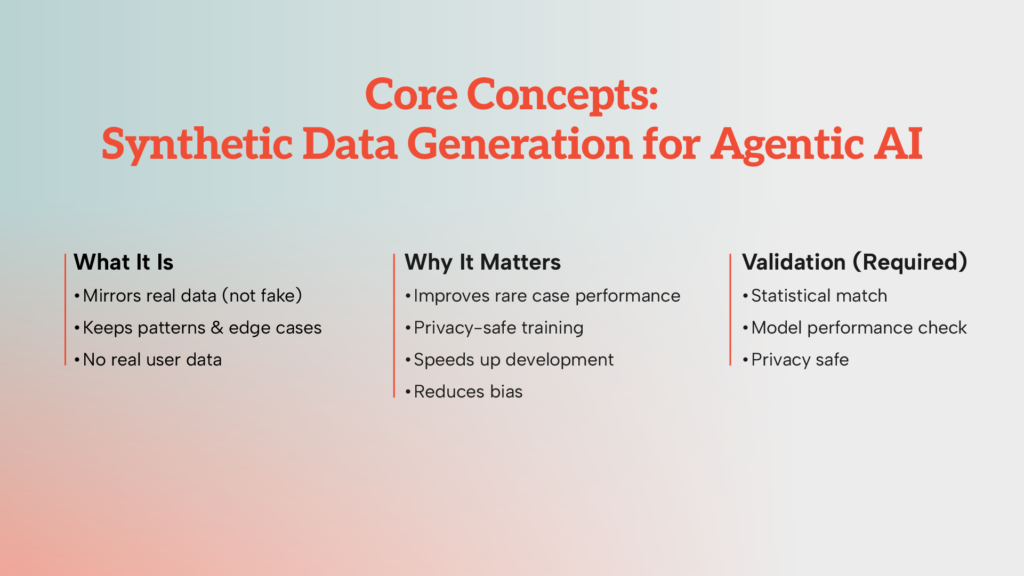
Synthetic data is artificially generated data that statistically mirrors the properties of real-world data without containing actual records from real individuals or events. It is not fabricated data invented without reference to reality. Properly generated synthetic data preserves the statistical distributions, correlations, edge cases, and domain characteristics of the real data it is modeled on, while introducing no privacy exposure.
This distinction matters because synthetic data is sometimes dismissed as a shortcut that trades quality for convenience. In practice, well-generated synthetic data does not merely approximate real data. In specific and important ways, it can improve on it.
Where Synthetic Data Adds Genuine Value
Addressing Class Imbalance and Edge Case Scarcity
Real-world datasets are rarely balanced. Fraud events are rare relative to legitimate transactions. Equipment failures are rare relative to normal operations. Adverse medical events are rare relative to routine encounters. Models trained on naturally imbalanced data tend to underperform on the rare classes that often matter most. Synthetic data generation allows teams to deliberately oversample rare but important scenarios, producing models that handle edge cases far more reliably than those trained on unaugmented real data.
Privacy-Safe Data for Sensitive Domains
In regulated industries, real customer and patient data is subject to strict access controls, retention limits, and usage restrictions that make it difficult to use for model training at scale. Synthetic data generated from real data, but containing no actual records, allows teams to train and test models on data that is statistically equivalent to production data without the regulatory exposure. This is not a workaround. It is an architecturally sound approach that regulators in multiple jurisdictions are increasingly recognizing as valid.
Accelerating Development in Data-Scarce Scenarios
New products, new markets, and new use cases often lack the historical data required to train reliable models. Synthetic data generation allows teams to bootstrap training datasets from domain knowledge, related datasets, and generative models before sufficient real data has accumulated. This compression of the development timeline is particularly valuable for organizations building AI capabilities in competitive markets where speed matters.
Systematic Bias Reduction
Real-world data encodes historical biases. Hiring data reflects past hiring decisions. Lending data reflects past lending decisions. Customer data reflects past customer acquisition patterns. Models trained on this data will reproduce and sometimes amplify those biases. Synthetic data generation, when designed with explicit fairness objectives, can produce training sets that are more representative of the intended population than historical data allows, producing models that perform more equitably across demographic groups.
Synthetic Data Validation: The Non-Negotiable Step
The value of synthetic data depends entirely on its fidelity to the real-world data it represents. Generating synthetic data without rigorous validation is worse than using limited real data, because it introduces systematic errors that are invisible to the teams using the data and are baked into every model trained on it.
Validation should operate at three levels. Statistical validation confirms that the synthetic dataset matches the distributional properties of the real data across all relevant variables and their interactions. Downstream model validation confirms that models trained on synthetic data perform comparably to models trained on real data when evaluated on held-out real examples. Privacy validation confirms that the synthetic data cannot be reverse-engineered to expose information about real individuals, using established privacy auditing techniques.
Organizations that implement all three validation layers can deploy synthetic data pipelines with confidence. Those that skip validation are building on a foundation they have not tested.
Core Concepts: Real-Time Data Pipelines for Agentic Systems
The Architecture Shift Required
Building data pipelines for agentic AI is not an incremental improvement on existing batch pipeline architecture. It requires a design philosophy shift: from pipelines that move data to storage on a schedule, to pipelines that deliver data to consumers the moment it is needed, at the latency the use case requires.
The key architectural elements of a real-time data pipeline for agentic systems are:
Event Streaming Infrastructure
The foundation of real-time data delivery is an event streaming layer that captures data changes as they occur and makes them available to downstream consumers with minimal delay. Technologies in this space provide the backbone for low-latency data delivery and are well-established in high-volume production environments. The design challenge is not the technology itself but the organizational work of connecting enterprise data sources to the streaming layer, which often requires significant integration effort.
Feature Stores with Low-Latency Serving
AI agents frequently need not raw data but computed features: aggregations, ratios, embeddings, and derived signals calculated from raw data. A feature store that can serve these computed features at low latency, consistently between training and inference environments, is a critical component of production agentic infrastructure. Without it, agents either receive raw data they must process themselves, which increases latency, or receive batch-computed features that may be hours out of date.
Context Management Layers
Agentic AI systems operating on multi-step workflows need to maintain and retrieve context across the duration of a workflow, sometimes spanning minutes, hours, or longer. This context includes the current state of the workflow, prior actions taken, retrieved information, and intermediate results. Designing a context management layer that is fast, consistent, and scoped correctly to each agent session is one of the more underestimated engineering challenges in agentic infrastructure.
Data Quality Monitoring in the Stream
In batch pipelines, data quality checks run as part of the processing job before data reaches consumers. In streaming pipelines, there is no processing job in the traditional sense, and bad data can reach agents faster than any human can intervene. Real-time data quality monitoring, running inline in the stream, is essential for catching schema violations, anomalous values, and missing data before they affect agent behavior.
Designing for Latency Requirements
Not all real-time is the same latency. Different agentic use cases have meaningfully different latency tolerance, and pipeline architecture should be designed to match those requirements rather than engineering for the most demanding case across the board.
Sub-second latency is required for use cases where agents are operating in interactive, customer-facing contexts: live chat routing, real-time fraud screening, and dynamic pricing decisions. Pipeline architecture for these use cases must minimize every source of delay and prioritize delivery speed above all other concerns.
Low-second latency (one to ten seconds) is adequate for many operational agentic workflows: document processing, task routing, and workflow orchestration. This tier allows for slightly more processing overhead and is achievable with well-designed streaming architectures without requiring the most aggressive infrastructure investment.
Near-real-time (seconds to a few minutes) serves monitoring, alerting, and reporting use cases where agents are synthesizing information and surfacing insights rather than taking time-sensitive actions. This tier can often be served by micro-batch architectures that provide most of the benefit of true streaming at lower operational complexity.
Mapping each agentic use case to its genuine latency requirement before designing pipeline architecture prevents both under-engineering, where agents receive stale data that degrades their usefulness, and over-engineering, where expensive low-latency infrastructure is built for use cases that do not require it.
Bringing the Two Together: An Integrated Data Strategy
Synthetic data pipelines and real-time data pipelines address different points in the AI system lifecycle, but they share infrastructure, governance requirements, and organizational ownership. Treating them as a unified data strategy rather than separate engineering projects produces several compounding advantages.
Synthetic Data Informs Real-Time Feature Design
The process of generating synthetic training data requires a precise specification of the features and data distributions that matter for a given model. This specification is exactly the input needed to design a production feature store: what features must be computed, at what granularity, and with what freshness requirements. Organizations that build synthetic data pipelines first often find that the work produces a detailed blueprint for their real-time feature store design.
Real-Time Data Feeds Continuous Synthetic Data Refresh
Production AI systems encounter data distribution drift over time. Customer behavior changes, market conditions shift, and the inputs agents receive in month twelve are often meaningfully different from the inputs they were trained on in month one. Real-time data pipelines, combined with automated synthetic data refresh processes, allow organizations to continuously update their training data to reflect current distributions, keeping models aligned with the reality they are operating in.
Shared Governance Reduces Overhead
Both synthetic data and real-time data pipelines require governance frameworks that address data quality, privacy, access control, and audit trail requirements. Building a unified governance layer that spans both pipeline types is significantly more efficient than building separate governance frameworks for each. It also produces more consistent controls, which matters as regulatory scrutiny of AI data pipeline practices increases.
Common Implementation Mistakes and How to Avoid Them
| Mistake | What Happens | How to Avoid It |
|---|---|---|
| 1. Generating Synthetic Data Without Domain Expert Involvement | Synthetic data is treated as purely statistical, leading to unrealistic edge cases, incorrect distributions, and missed anomalies. This results in models trained on data that looks right but behaves wrong in production. | Involve subject matter experts throughout both design and validation. They define what “realistic” actually means, validate distributions, and identify edge cases that data teams alone will miss. |
| 2. Building Real-Time Pipelines for Batch-Oriented Agents | Teams over-invest in streaming infrastructure that agents don’t actually use. This creates unnecessary complexity, cost, and operational overhead without improving outcomes. | Align infrastructure decisions with agent behavior. If agents operate on batch queries or workflow-based execution, prioritize simplicity over real-time capabilities. |
| 3. Treating Feature Store Implementation as Optional | Feature logic gets pushed into agents, creating latency, inconsistency between training and inference, and duplicated logic across systems. | Implement a centralized feature store early. This ensures consistency, reduces latency, and creates a single source of truth for feature engineering across training and inference. |
| 4. Skipping Drift Monitoring | Data pipelines degrade over time. Synthetic data becomes misaligned with reality, and real-time data quality deteriorates as upstream systems change. | Establish continuous drift monitoring across both synthetic and real-time data. Automated detection ensures pipelines remain aligned with real-world conditions over time. |
| 5. Separating Data Infrastructure from AI Product Teams | Pipelines are built without understanding real product needs, leading to mismatched latency, poor feature definitions, and data that doesn’t support agent behavior. | Treat AI product teams as primary stakeholders in pipeline design. Infrastructure teams execute, but product teams define requirements that determine whether the system delivers value. |
Success Metrics for AI Data Pipelines and Infrastructure Investment
Synthetic AI Data Pipeline Metrics
- Statistical fidelity score comparing synthetic distributions to real data across key variables
- Model performance on real held-out data when trained on synthetic data versus real data (the closer to parity, the higher the fidelity)
- Edge case coverage rate: the percentage of known rare scenarios represented in the synthetic training set
- Privacy audit pass rate confirming no re-identification risk
- Training data refresh cycle time: how quickly new synthetic data can be generated in response to distribution drift
Real-Time Pipeline Metrics
- End-to-end data latency by use case and pipeline tier
- Data freshness at time of agent consumption: the average age of data when an agent reads it
- Pipeline availability and uptime for production agentic workloads
- Data quality exception rate: the percentage of records failing inline quality checks
- Feature store cache hit rate: the proportion of feature requests served from cache versus recomputed
Integrated Program Metrics
- Time from model concept to production-ready training data
- Agent decision accuracy on time-sensitive tasks, as a function of data freshness
- Total data infrastructure cost per agent workflow execution
- Compliance incident rate attributable to data pipeline issues
Where Data Infrastructure for AI Is Heading
Generative Models as Data Infrastructure
Large generative models are becoming a first-class component of synthetic data pipelines, not just a training output. The ability to generate domain-specific synthetic data from natural language specifications, rather than explicit statistical programming, is compressing the time and expertise required to build high-quality synthetic datasets. Teams that learn to work with generative models as data infrastructure tools will move significantly faster than those relying on traditional synthetic data generation techniques alone.
Unified Training and Serving Architectures
The boundary between training pipelines and serving pipelines is blurring. Architectures that allow models to be continuously updated from production data streams, rather than periodically retrained from static snapshots, are moving from research to enterprise production. For organizations with high-volume agentic deployments, this shift will change the economics of model maintenance significantly.
Federated Data Pipelines for Multi-Organization AI
As AI increasingly involves collaboration across organizational boundaries, federated data architectures that allow model training and feature computation without centralizing sensitive data will become a standard enterprise requirement. Organizations investing in privacy-preserving data infrastructure today, including synthetic data generation, are building the foundation for participation in these emerging collaborative architectures.
Conclusion and Final Thoughts
The AI programs that will scale most effectively over the next several years will be built on data infrastructure designed for the demands of autonomous systems, not adapted from infrastructure designed for a previous generation of analytics and reporting. Synthetic data pipelines and real-time data architectures are not advanced capabilities reserved for technology leaders. They are the baseline requirements for AI programs that intend to operate at scale, with reliability, and with the quality of intelligence that autonomous agents require to deliver genuine business value.
Ready to assess the maturity of your AI data infrastructure? Contact our team to discuss a data pipeline review and identify the highest-priority investments for your agentic AI program.