Introduction
As one of the most established academic institutions in the United States, this organization is renowned for its leadership in research, education, and innovation. Its dedicated technology services team supports a vast library network by providing robust systems and maintaining reliable enterprise applications. These tools enable seamless research, discovery, and access to knowledge for students, faculty, and academic partners across the institution.
The Project at a Glance
The Assessment: Migration and Modernization
The assessment revealed several critical areas for improvement, including introducing and centralizing a Kubernetes (K8s) platform and associated tools for logging and monitoring, fully automating the continuous integration (CI) portion of the pipeline, introducing security practices, formalizing Agile practices, and centralizing knowledge management. Oteemo defined the strategy to implement and support application modernization and adoption of modern DevSecOps platform and practices, straddling legacy systems using the new tooling to avoid disruption to existing applications and Library operations.
Additionally, Oteemo recommended its approach of dedicated embedded expertise (DE2), offering senior engineers to partner with the client’s technologists and product teams to build, model, and apply best practices real-time during application modernization efforts. This upskilling approach is based on Oteemo’s experience building in-house capacity to manage and sustain new capabilities; as a critical success factor for most projects, Oteemo prioritizes professional development of resident technologists to support mindset and culture shifts and limit overall long-term costs for the organization.
Beyond Technical Strategy: Enablement through Execution
Oteemo initiated the project with a proof of value (PoV), building a “slice” of the recommended technology changes prior to launching a full-scale migration effort. Oteemo and the client applied a teaming model, having the client’s engineers partnering with Oteemo expert technologists to learn real-time about DevSecOps and containerization. The team focused on the transition from Docker Swarm to K8s platform, migrating 32+ containerized applications from Docker Swarm to K8s.
The client gained access to specialized engineers who guided planning and generated options for navigating the complexities of modernizing the client’s infrastructure at critical decision points. In aligning Oteemo’s capabilities with client’s objectives, the partnership ensured the client’s teams were upskilled and ready to support the new modern container platform tailored to address the clients’s unique needs and challenges. The partnership continues to focus on expanding the total number of applications to migrate to the new modernized infrastructure so that all legacy systems can be deprecated by the end of 2024, with 31 in development and 10 in production after 12 months.
Organizational Strategy Key for Sustainable Growth
The University recognized the need to transition from its older container technology to a scalable container orchestration solution capable of supporting the extended enterprise-wide network of libraries. The University needed a strategy to address the systems performance issues that were preventing the client from providing timely solutions to customer needs or adapting technical support to meet emerging service requests. The client engaged Oteemo, a trusted collaborator in DevSecOps implementation, to conduct a comprehensive assessment in Spring 2023. The assessment identified opportunities to mature and modernize client’s operations and platforms, identifying the need to modernize the underlying infrastructure to improve system performance, operations, and the client’s team productivity. The infrastructure was an essential change to realize system stability and reliability and reduce unnecessarily long deployment times that degraded trust and confidence in the current client’s operations. The strategic partnership between the client and Oteemo paved the path for container adoption and DevOps.
Implementation of Application Modernization with Containerization
Oteemo advised the University to layer a series of tools and practices, including Infrastructure as Code (IaC) and Terraform that enabled rapid and synchronized environment configuration and instantiation, to support business goals of system stability and performance. The approach leveraged a combination of Kubernetes with RKE2/Rancher, GitOps (Argo CD), and a service mesh (Istio) to allow migrating client’s applications to be operational on Day 1 of deployment, avoiding unnecessary interim work on legacy systems that would not be recouped downstream. CI pipeline automation through GitHub Actions ensured efficient and consistent application delivery, once the platform was established.
Oteemo also wanted the client to more efficiently manage system performance, introducing Logging and Monitoring as part of the initial platform build with Promtail-Loki-Grafana (PLG) tooling. The larger business goal was to allow engineers to automate system health and maintenance, so time was effectively spent on mitigating high-risk issues and resolving low-risk issues early and before they impacted the client‘s users’ experience. Similarly, to avoid unnecessary vulnerability and security risks, especially considering client’s extended global user base, Oteemo applied AWS Secrets Manager with Kubernetes External Secrets Operator and added CrowdStrike Falcon for vulnerability scanning. Collectively, these actions significantly reduced operational costs for the client and freed the client‘s engineers to work on higher priority issues and future service enhancements.
Oteemo made sure that the engineering teams were cross-functional and had the client’s technologists embedded with Oteemo technologists to enable joint problem-solving and upskilling. It applied Agile practices to all its delivery efforts, modeling and supporting adoption of the cross-functional collaboration essential for true DevSecOps adoption and technical solutions that could adapt to users’ changing requirements over shorter software development lifecycles. Centralizing templates, knowledge, and documented plans and expertise (e.g., runbooks) allows for the initial PoV team to scale capability across clients efficiently.
The Results?

Oteemo and The University: Integrated Transformation Outcomes
Throughout the journey with Oteemo, the client successfully transformed its operations and achieved significant milestones in container adoption and DevOps transformation. The introduction of a standardized Kubernetes platform and associated tools, through Oteemo’s guidance, has enabled the client to successfully transform its operations and achieve significant milestones in container adoption and DevOps transformation.
The introduction of K8s platform has provided the following benefits:
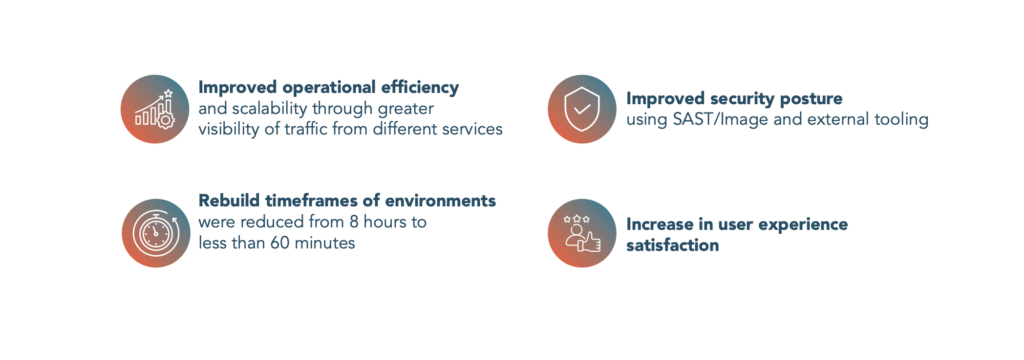
- Improved operational efficiency and scalability.
- Automated CI pipelines streamlined application delivery, enhancing the capability to rebuild DEV/QA environments so expected rebuild timeframes of 6-8 hours were reduced to less than 60 minutes, a reduction of almost 90%.
- Fortified security practices, ensuring compliance and protection against vulnerabilities that have stabilized environments and improved security levels from 50% to 80%.
Formalized Agile practices and centralized knowledge management that facilitated collaboration and innovation across teams, driving organizational agility and resilience and increasing the user experience satisfaction ratio from 70% to 90%.
The collaboration between the client and Oteemo exemplifies the power of strategic partnerships to achieve digital transformation and business objectives. In leveraging Oteemo’s expertise and guidance, the client was able to overcome operational challenges, implement best practices, and accelerate its modernization journey. This partnership not only delivered tangible results but also fostered a culture of continuous improvement and innovation within the client, positioning it for future success in an increasingly challenging competitive landscape of increasing service demands.